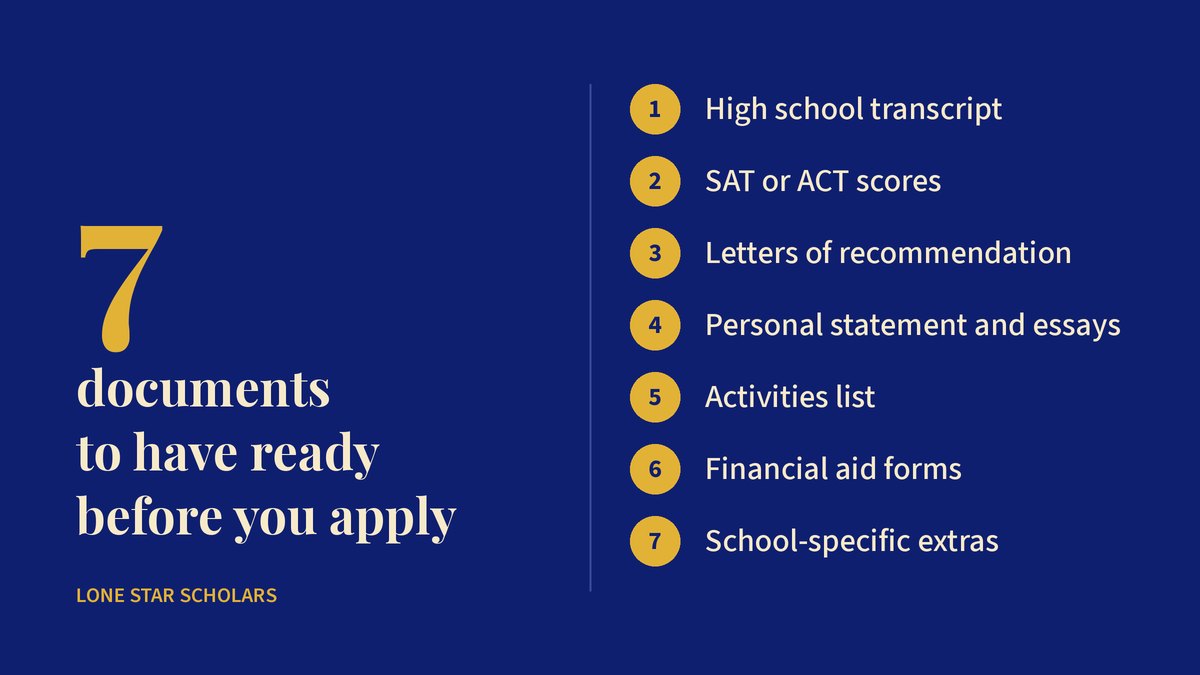
Most U.S. college applications draw on the same seven documents: a high school transcript, SAT or ACT scores (or a decision not to send them), letters of recommendation, a personal statement and essays, an activities list, financial aid forms, and whatever extras a particular school or student situation adds.
Two of those are conditional. Test scores depend on the schools on your list, and aid forms apply only if you are seeking aid. A missing required document can stall a review, and a final transcript that never arrives can hold up enrollment after admission.
For seniors, November 1 early deadlines are here, so the working window now is January regular decision. Juniors can skip the scramble by starting this list in the spring. Below is what each document involves, who actually sends it, and what changes at schools many Collin County families have on their lists.
Key takeaways
- Seven documents, two conditional: Transcript, test scores, recommendations, essays, activities list, financial aid forms, and school-specific extras. Scores depend on your college list, and aid forms depend on whether you are seeking aid.
- Official means sent by the school: Many colleges accept a self-reported or uploaded transcript during review, then require an official one after admission.
- Testing depends on your list: For fall 2027 entry, MIT, Harvard, Stanford, Yale, and UT Austin require the SAT or ACT. Texas A&M and Princeton are test-optional.
- The FAFSA is already open: The 2027-28 form launched on September 23, 2026, and the Texas priority date for state aid is January 15, 2027.
- Recommenders need lead time: Give teachers at least six to eight weeks' notice, and build your timeline backward from your earliest deadline.
1. High school transcript: what does "official" mean?
Your transcript is the academic backbone of your application, and colleges use it to evaluate the rigor of your coursework alongside your grades. Many schools accept an uploaded or self-reported transcript during initial review but require an official document after admission and before enrollment. "Official" has a specific meaning here: the transcript must come directly from your school, either electronically through an approved service or in a sealed envelope. A PDF you download from your student portal does not qualify.
On the Common App, your school counselor uploads the transcript along with the school forms, so this is not something a student submits alone. Many colleges also ask for a mid-year transcript once first-semester senior grades post, and a final transcript after graduation to confirm you finished what you reported.
Frisco ISD families should ask their campus counseling office how requests work and ask early, since district counselors carry roughly 420 students each.
2. SAT or ACT scores, or a decision not to send them
The answer depends entirely on which schools are on your list. For fall 2027 entry, Brown, Cornell, Dartmouth, Harvard, Penn, Yale, MIT, Stanford, Georgetown, and Caltech require SAT or ACT scores, and so does UT Austin. Texas A&M does not, and Princeton remains test-optional for fall 2027 entry.
Across a wider group, the National Test Prep Association's policy tracker counted 70 of 417 colleges requiring scores as of October 2026, including 22 that allow exceptions, and that group includes 15 of the top 20 national universities. Policies shift quickly, so check each school's own admissions page before relying on any list, this one included. We looked at how these policies fit into the wider academic picture in what the Common Data Set actually shows.
The three testing categories
Test-required. These schools need scores, and how you send them varies. UT Austin wants official scores sent by the testing agency, received by December 10 for its regular deadline, and it also accepts the Classic Learning Test.
Test-optional. You choose whether to send scores. Princeton says applicants without them "will not be at a disadvantage," but that tracker also finds that 91% of the colleges it follows consider scores when they are sent. If your score sits at or above a school's middle range, sending it is usually worth considering. If it falls well below, holding it back is generally the stronger move.
Test-blind. Schools like the University of California system will not use scores in admissions decisions at all, so sending them will not help.
3. Letters of recommendation
Selective colleges commonly ask for a counselor recommendation plus one or two teacher letters. Yale, for example, asks for two letters from teachers of core academic subjects. Requirements vary widely, though: at UT Austin, letters are optional.
Choose recommenders who know your work closely in a relevant subject, not simply the teachers who gave you the highest grades. A letter with specific examples of your thinking, curiosity, or growth carries more weight than a generic positive one, and we broke down what teachers are actually asked to rate.
Ask at least six to eight weeks before your earliest deadline. On the Common App, you add a teacher to your list and then assign them to a college, which is the step that sends the invitation email. Check each school's submission policy before assuming a mailed or emailed letter will count, and follow up with your recommenders a week or two before the deadline.
4. Personal statement and supplemental essays
The Common App personal essay runs up to 650 words and serves as your primary narrative voice in the application. Supplemental essays vary by school, from a short "why us" response to several longer prompts. Both are submitted inside the application platform, not as separate attachments. Tailor every supplement to the school it is going to, because a recycled answer is easy to spot.
Check which platform each school uses before you start writing. UT Austin uses the Common App for summer and fall admission and not ApplyTexas, while Texas A&M takes either one. Many other Texas publics still run on ApplyTexas.
5. Activities list
The activities section allows up to ten entries on the Common App, each with a brief description, and you do not need to fill all ten. Many students list activities without describing their actual role or impact. Lead with your most significant activities and write descriptions that show depth of involvement, not just participation.
Students with independent research, published work, or community projects should make those visible here rather than burying them under standard extracurriculars. At Lone Star Scholars, we work with students to frame those experiences so they are clear to admissions readers. For more detail, see what colleges do with your activities list and our Common App activity list examples.
6. Financial aid forms, if you are seeking aid
These forms are not required to apply. They are how you get considered for aid, and missing a priority date can cost you money.
The FAFSA is the form for federal aid, and many states and colleges use it too. The 2027-28 form launched on September 23, 2026, ahead of the October 1 date the law sets as the latest it can open. The Texas priority date for state aid is January 15, 2027, though private and two-year colleges may set different dates.
The CSS Profile is a separate form that colleges use to award their own aid. The College Board's 2027-28 participating list has about 260 entries, including colleges, professional schools, and scholarship programs. Most are private, including Rice, SMU, and TCU here in Texas, but public universities such as Michigan, UNC, and Virginia use it too.
What to gather for each form
The two forms ask for different things. The FAFSA transfers federal tax information directly from the IRS, so the key step is consent: if a required parent or spouse does not approve the transfer, the student will not be eligible for federal aid, even if the numbers are typed in by hand. Keep bank and investment records handy for the asset questions.
The CSS Profile asks for more, including your most recent federal tax returns, W-2 forms, and other income records. We compare the two in detail in our FAFSA vs. CSS Profile guide.
Many college priority dates fall in November for early applicants and in January or February for regular decision, so check each school's financial aid page. Students from lower-income households should also ask about application fee waivers through the Common App or each school.
7. School-specific extras
The last category is whatever your particular schools and situation add. Art and music programs often require a portfolio or audition recording, and transfer applicants need prior college transcripts as well as high school records.
International applicants usually add English proficiency scores such as TOEFL, IELTS, or Duolingo, and some schools require translated transcripts or a credential evaluation. After admission, schools must collect proof of funds before issuing Form I-20, which is needed for the F-1 student visa along with a DS-160 form, an I-901 SEVIS fee receipt, and usually an interview. Each school's international admissions page holds the definitive checklist.
The safest habit for every applicant is to pull the admissions checklist from each school's official website rather than assuming requirements match across your list.
Getting every document right before your deadlines
The coordination is the hard part. Recommendations depend on other people's schedules, transcripts and school forms run through your counseling office, test scores come from the testing agency, and financial forms have their own priority dates. Starting early is the only reliable way to avoid gaps.
Families across Frisco, McKinney, Allen, and Plano work with Lone Star Scholars well ahead of application season for exactly that reason. We are based in Frisco and meet virtually or in person, and we help students build a personalized checklist that accounts for each school on their list, tracks deadlines, and catches gaps before they become problems.
If you want a clear view of what your student needs and a plan to have it ready on time, book a free consultation or contact our team.
Frequently Asked Questions
When should we request transcripts and ask teachers for letters of recommendation?
Ask teachers at least six to eight weeks before your earliest deadline, and raise transcript requests with your counseling office on the same timeline. Remember that mid-year and final transcripts come later, so the process does not end when you submit.
What happens if a required document arrives after a school's deadline?
It depends on the school. A late document can delay your review or leave your file incomplete, and some schools are strict: UT Austin says official scores must be received by the appropriate deadline for an application to be considered. If something will be late, contact the admissions office right away.
Do we have to submit both the FAFSA and the CSS Profile to every college on our list?
No. File the FAFSA if you are seeking federal aid, and many states and colleges use it as well. The CSS Profile is needed only at schools and programs on the College Board's participating list.
Who sends which documents?
On the Common App, your counselor sends transcripts and school forms, and teachers upload their own letters. Students submit their own essays and activities list. Where official scores are required, they come from the testing agency, and financial aid forms go through the FAFSA and CSS Profile sites.
Ready to Get Started?
Schedule a free consultation to discuss your student's goals and create a personalized plan.
Book Free Consultation