
Early deadlines aren't new, but in the last few years they've turned into the main arena for selective admissions.
Common App reports that early applications keep rising—both unique applicants and total applications went up again in the 2024–25 cycle, continuing a decade-long trend of more students applying to more colleges. At many selective schools, a large share of the freshman class is now admitted in early rounds, often with acceptance rates that are noticeably higher than Regular Decision.
For Texas families—especially those looking at Rice, UT Austin, SMU, TCU, Trinity, and out-of-state selective colleges—understanding Early Decision (ED), Early Decision II (ED II), and Early Action (EA) is now a key part of planning, not just jargon.
Here's a plain-language breakdown for parents.
The Basics: ED, EA, ED II, and Regular Decision
Early Decision (ED)
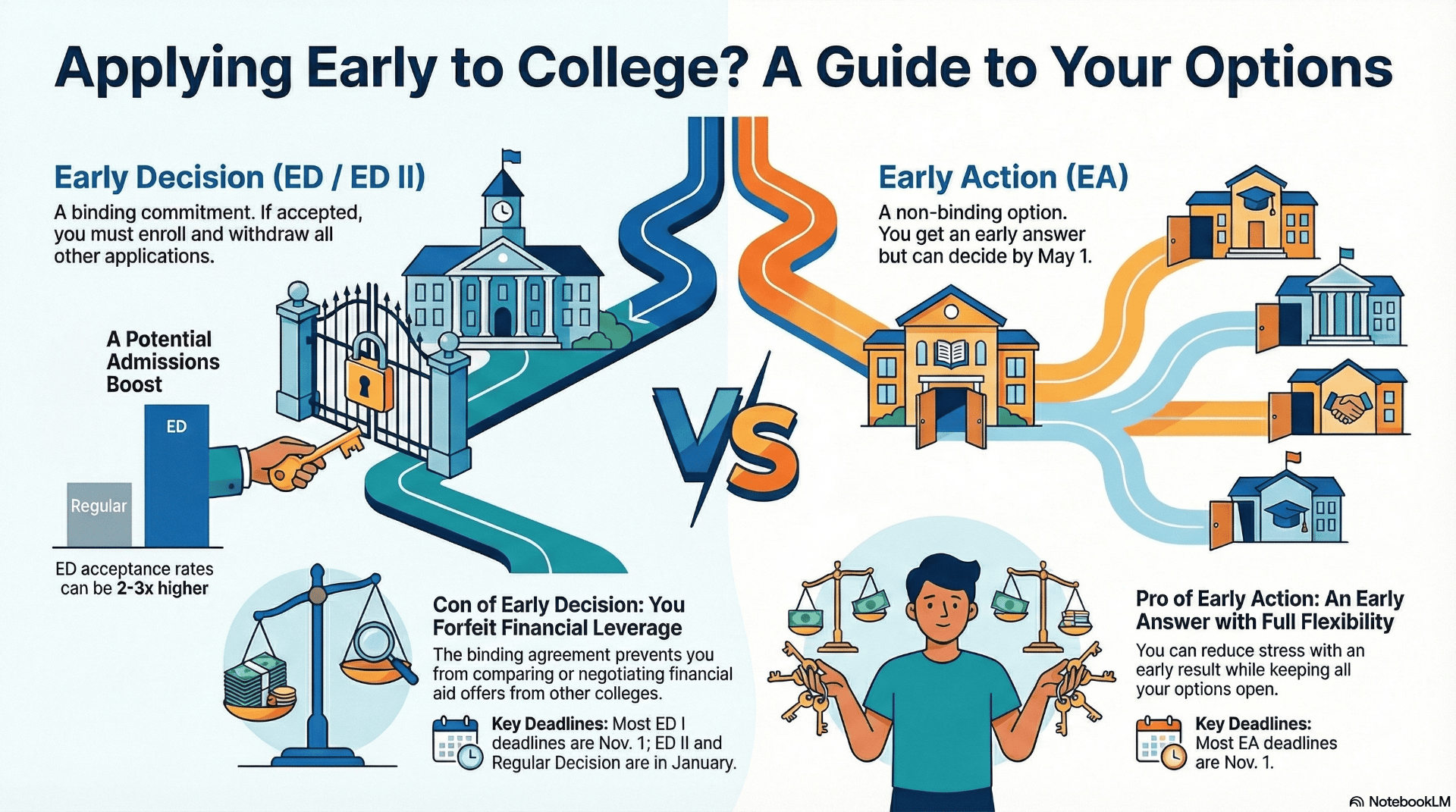
- Binding: If a student applies ED and is admitted, they are expected to enroll and withdraw all other applications.
- Timeline: Most students apply by November 1 and hear back in mid-December. Many colleges call this ED I.
- Who uses it: Private, selective colleges rely on ED the most. Some admit a big portion of their class in this round, with ED acceptance rates often 2–3x higher than Regular Decision at the same school.
Example: Brown University's Early Decision admit rate for the Class of 2029 was about 17.9%, much higher than its overall admit rate, which is still in the single digits.
ED can look very appealing—but the binding commitment is a serious step, especially for families who want to compare financial aid.
Early Action (EA)
- Non-binding: Students apply early and receive a decision earlier, but they do not have to commit until the standard reply date (usually May 1).
- Timeline: Deadlines are often in early November, with decisions in December or January.
- Who uses it: Both public and private universities, including large state schools.
For example, UT Austin uses an early action–style timeline, releasing early results in January before regular decisions in February. EA is usually low risk if the student is academically ready by the early deadline: you get an earlier answer and still keep the option to compare offers.
There are stricter versions of EA—like Restrictive Early Action (REA) or Single-Choice Early Action—where you may only apply early to that one private college (with some exceptions). These plans are still non-binding but come with extra limits on other early applications.
Early Decision II (ED II)
This is the piece many families still do not know much about.
- Also binding, just like Early Decision I.
- Later deadline: Typically due in early January, similar to Regular Decision.
- Who offers it: A growing group of selective colleges, including Rice University, which added ED II starting with the 2024–25 cycle. Rice's ED II deadline is in early January, with decisions released by mid-February.
Think of ED II as a "second chance" Early Decision round: if a student doesn't apply ED I anywhere, or is denied or deferred in ED I at another school, they can still make a binding commitment to a different college in January.
From a strategy standpoint, ED II gives colleges another chance to admit committed students and gives students another shot at an early-round bump—with the same binding commitment and financial-aid trade-offs as ED I.
Regular Decision (RD)
- Non-binding, with decisions usually released in March or early April.
- Deadlines: Often January 1–15 for the 2025–26 cycle, though some schools extend into late January or February.
- Pros: More time for students to raise grades, retake tests, and update their college lists.
- Cons: At some selective colleges, many seats may already be taken by ED/EA admits.
Does Applying Early Really Help?
Short answer: often yes—but not for everyone, and not without trade-offs.
Recent reviews of Common Data Set releases and school reports show that at many highly selective colleges, Early Decision admit rates are much higher than Regular Decision rates. In some cases, ED acceptance rates are double or more.
But it's important to understand why:
- ED pools often include more recruited athletes, legacies, and very strong students, which raises the ED admit rate.
- Colleges like ED because it helps them predict yield (how many admitted students will enroll), which matters for rankings and financial planning.
- ED II adds another wave of committed students later in the cycle and can reinforce this pattern.
Meanwhile, early application volume keeps growing. Common App data show steady increases in applications filed before early deadlines, with early rounds now taking a larger share of total applications than a decade ago.
So yes: in 2025, applying early—especially ED/ED II—can create an advantage, but it's not a guarantee. It tends to work best for students who are already strong, organized, and truly ready by late fall.
Binding vs. Non-Binding: The Real Trade-Off
The core split is simple:
- ED / ED II = Binding
- EA / REA / RD = Non-binding
When a student applies Early Decision or Early Decision II, they are making a serious promise. If admitted and the financial aid offer is workable, they are expected to attend and withdraw all other applications. That means:
- No comparing merit offers across multiple colleges.
- Less room to push for better financial aid.
- Less time to rethink academic and personal fit.
This setup has drawn more attention in recent years. In August 2025, NACAC (the National Association for College Admission Counseling) updated its Guide to Ethical Practice in College Admission, revising ED agreement language so families better understand the impact of a binding commitment before they sign.
A 2025 class-action lawsuit against several elite colleges also argues that Early Decision can limit students' ability to compare offers and may push tuition higher by reducing competition for those applicants.
The message for families: ED can help, but it also narrows your choices. It should only be used when:
- The student has a clear, well-researched first-choice college.
- The family has used tools like the Net Price Calculator and believes the college will be affordable.
- The student's academic record is already strong by the end of junior year (and test scores are ready if the school requires them).
Where This Shows Up for Texas Students
For Texas families, early options are not just an "East Coast Ivy" issue. A few examples:
- Rice University (Houston) now offers ED I and ED II, both binding, with November and early January deadlines.
- UT Austin uses an early timeline (Early Action style) for many applicants, releasing early results in January and regular decisions in February.
- Other Texas privates like Trinity University, SMU, TCU, and Baylor use mixes of Early Decision, Early Action, and Regular Decision, with many key deadlines near November 1 and February/March decision dates.
On top of that, Texas has its own priority financial aid timelines (for example, a state priority deadline in mid-February) that families must track, regardless of early admission plans.
Because policies and deadlines change from year to year, it's important to check each college's website directly before making any final plans.
Pros and Cons at a Glance
Early Decision / Early Decision II
Possible advantages:
- May offer a statistical edge at some selective colleges.
- Signals clear, strong interest, which schools value.
- Earlier answers—admitted students can breathe a bit and focus on finishing senior year well.
Possible drawbacks:
- A binding commitment limits your ability to compare financial offers.
- Less flexibility if a student's interests or family circumstances change.
- Pressure on students to finish testing, essays, and big decisions by early fall of senior year.
- ED II carries the same issues, just on a January timeline.
Early Action (and Restrictive Early Action)
Possible advantages:
- Non-binding: students can still compare offers and apply broadly.
- Earlier decisions, which can lower stress and help refine the college list.
- Often little downside if the student is ready—an EA denial does not block Regular Decision at other schools (though REA plans may limit other early applications).
Possible drawbacks:
- Students still need to be organized and application-ready by November.
- At some colleges, EA pools are very competitive because many strong students apply early.
Regular Decision
Possible advantages:
- More time to improve grades, retake tests, and build activities during fall of senior year.
- Full ability to compare financial aid and merit scholarships across multiple offers.
Possible drawbacks:
- At some selective schools, many seats are already taken by early applicants.
- Waiting until March/April for decisions keeps uncertainty going longer.
How to Decide in 2025: A Simple Framework
Here's a practical way to think about ED, ED II, and EA for your student:
- Is there a true first-choice college?
- If one college clearly stands out and your student has visited (in person or virtually), researched programs, and understands campus culture, ED or ED II might make sense.
2. Is the family comfortable with the financial commitment? ED/ED II are binding. Run the school's Net Price Calculator and read its aid policies before agreeing to a binding plan.
3. *Is the student's academic profile ready now?* If grades, course rigor, and (if needed) test scores are already strong by the end of junior year, early options are more appealing. If the student needs fall of senior year to repair a GPA or raise scores, RD or EA may be better.
4. Does the student need comparison and flexibility? If your family needs to compare scholarships and aid offers, or your student is still unsure between several colleges, non-binding EA and RD usually make more sense.
5. Is the student emotionally ready for a binding decision at 17? Some students feel relieved by an early "yes." Others feel boxed in. The student's comfort level matters here as much as the numbers.
Final Thoughts for Texas Families
In 2025, Early Decision, Early Decision II, and Early Action are not just labels—they are tools that shape how and when students receive offers. Used with care, they can help a student secure a place at a good-fit college earlier in the process. Used without that care, they can limit options, rush choices, or add financial strain.
For many Texas students, a sensible plan might include:
- EA to one or more good-fit schools for an early read.
- A carefully chosen ED or ED II only if the academic, financial, and emotional boxes are all checked.
- A well-built Regular Decision list to keep options open.
As policies, deadlines, and testing requirements keep shifting—some top schools have brought back testing and are seeing changes in early application patterns—staying up to date matters more than ever. Always check each college's current rules on its official website.
And if you want another set of eyes on whether ED, ED II, or EA fits your student's profile and your family's budget, this is exactly the kind of planning a college counselor can walk through with you calmly and clearly.
Ready to Get Started?
Schedule a free consultation to discuss your student's goals and create a personalized plan.
Book Free Consultation


