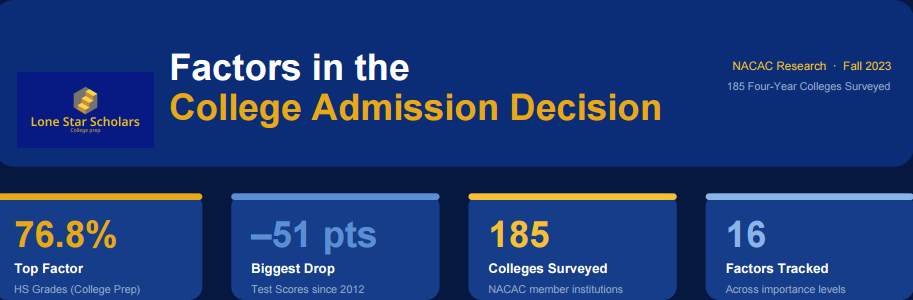
💡 TL;DR: NACAC's 2023 survey shows only 6.5% of colleges rate extracurriculars as having "considerable importance," while grades and course rigor dominate. But that doesn't mean extracurriculars don't matter—they matter as narrative glue. The right activities help colleges understand who a student is, what they care about, and whether they can sustain meaningful effort. The wrong approach is "activity soup" done for resume padding.
First, An Exciting Note Before We Jump Into Data
We're excited to share that Abhi was recently interviewed for a podcast by Buddy Broyles of Blue Mic Studios, where we talked about admissions myths, data-driven planning, and what families often misunderstand about the process.
We'll share the episode link as soon as it's released.
Until then, we hope this data helps bring clarity—and calm—to conversations about extracurriculars.
We frequently hear a version of the same question from families:
✨ "What should my student be doing for extracurriculars?"
It's usually followed by a long list of clubs, competitions, leadership titles, and summer programs someone else's kid is doing.
Rather than answering that question with opinions or anecdotes, we want to share something better: actual data on how colleges evaluate applications. One of the most widely cited sources is the annual NACAC State of College Admission survey, which asks colleges directly what matters most in admissions decisions.
Below, we'll walk through what the data says—and what it doesn't say.
What Colleges Say Matters Most
According to the Fall 2023 NACAC survey of 185 four-year colleges, the factors most often rated as having "considerable importance" are:
- High school grades in college-prep courses
- Overall high school grades
- Strength of curriculum
Extracurricular activities? Only 6.5% of colleges rated them as having "considerable importance." Here's the full breakdown:
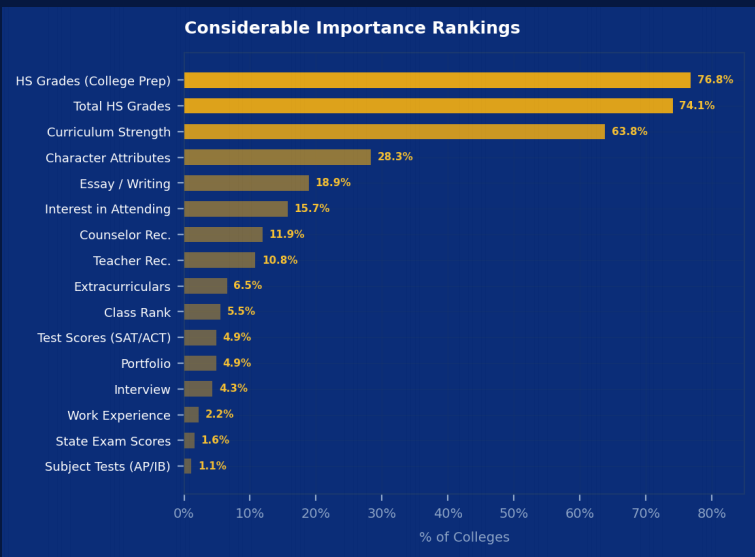
Source: NACAC State of College Admission (Fall 2023) survey of 185 four-year colleges.
At first glance, that number surprises families—and sometimes leads to the wrong conclusion.
The Big Trend Everyone Should Notice
The historical data tells an even more interesting story. Over the past decade, some factors have stayed remarkably stable, while others have shifted dramatically.
The most dramatic change? Standardized test scores. From 2012 to 2023, the percentage of colleges rating SAT/ACT scores as "considerable importance" dropped by 51 percentage points, reflecting the widespread move to test-optional and test-free admissions.
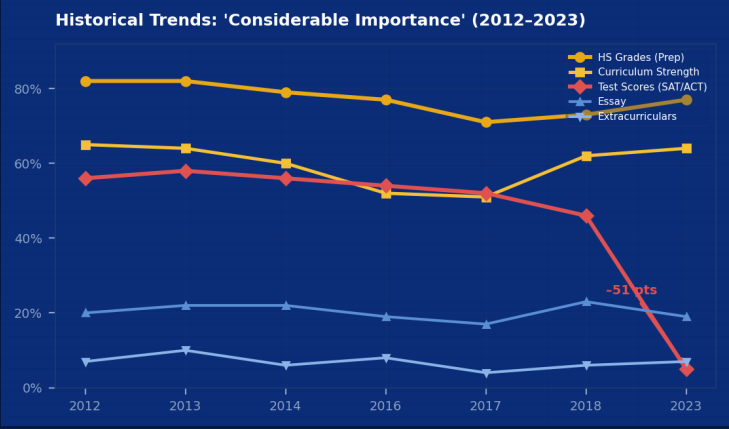
Key shift: test scores drop sharply; grades and curriculum remain consistently high.
Grades and curriculum strength remain consistently dominant. Essays and extracurriculars remain lower—but steady.
Update, October 2026. The drop in test scores describes 2012 to 2023, and it has not continued. In Common App's 2025-26 end-of-season report, the number of applicants reporting a test score grew 11% while the number applying without one fell 5%. For students entering in fall 2027, Harvard, Yale, MIT, Cornell, Georgetown and UT Austin require scores. We cover the shift in what colleges do with your activities list and the school-by-school requirements in what top universities report about their admitted students. Read the chart above as history, and check each college's own testing policy.
So… Do Extracurriculars Matter or Not?
Yes. Deeply. Just not in the way families often think.
The NACAC survey measures whether a factor by itself is decisive. Extracurriculars are rarely a standalone decision-maker. But they play a crucial supporting role in three ways the data doesn't directly capture:
- Narrative building: Extracurriculars help explain who a student is beyond the transcript—interests, values, motivation.
- Meaning and direction: Strong activities show whether a student can channel curiosity into sustained, meaningful effort.
- Credibility: When essays, recommendations, and course choices align with activities, the application feels coherent and authentic.
In other words, extracurriculars don't win the case alone—but they help the rest of the application make sense.
What Doesn't Work: Resume Padding
What colleges see immediately (and repeatedly) are applications that look like this:
- A long list of unrelated clubs
- Leadership titles without substance
- Activities chosen because "they look good," not because they mattered
Random bullet points don't create impact. Narrative does.
Colleges aren't asking, "How busy was this student?" They're asking, "What did this student care about enough to stick with?"
The Takeaway for Families
If you remember only one thing from this data, let it be this:
✨ Extracurriculars are not about quantity or prestige. They're about coherence.
The strongest profiles aren't built by chasing what other students are doing. They're built by:
- Choosing activities that genuinely fit the student
- Sticking with interests long enough to create depth
- Letting grades, courses, essays, and activities tell the same story
That's how extracurriculars quietly do their real work.
💛 — Lone Star Scholars
Source reference: NACAC State of College Admission survey summary (Fall 2023).
Ready to Get Started?
Schedule a free consultation to discuss your student's goals and create a personalized plan.
Book Free Consultation