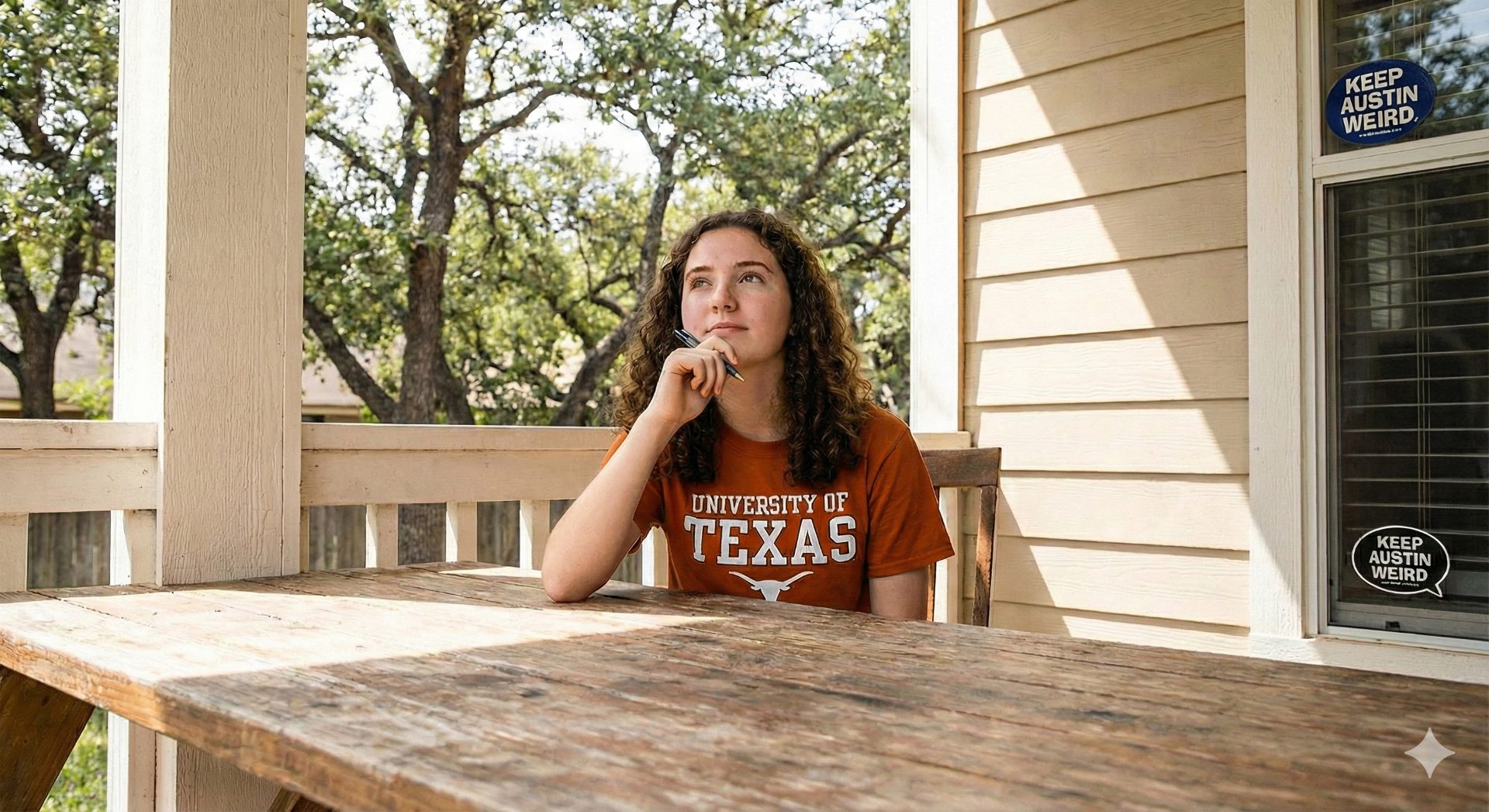
On the night of July 31, somewhere in Frisco, a rising senior stayed up to watch the clock roll over to August 1 and made a Common App account at 12:04 a.m. Somewhere else in Frisco, a rising senior had no idea the date was a milestone and was at a 7-on-7 tournament.
Both were fine. That's the strange thing about the application opening: it's a genuine event, and almost nothing about it is urgent. The portal going live changed what's possible, not what's due. The families who handle August well are the ones who understand the difference.
Here's what actually opened, what's true for this specific class, and what's worth doing now.
📅 Since this was published: Our Summer Research Program Symposium took place on Sunday, August 9 at our Frisco office, where scholars presented the work they'd spent ten weeks building. See the recap.
What Actually Opened on August 1
The Common App and ApplyTexas both went live for fall 2027 entry. Accounts, essay prompts, and the activities section are all accessible right now.
One thing to get straight before anyone starts clicking: UT Austin does not use ApplyTexas. UT moved to the Common App for summer and fall admission, and its only other front door is the separate Spring App for spring entry. Texas A&M takes either one — Common App or ApplyTexas — and says the choice doesn't affect the decision. ApplyTexas is still the workhorse for Texas Tech, UT Dallas, UNT, and Houston. If your student built a mental plan around "we'll just do ApplyTexas," UT is a separate application.
Nothing is due. The first real Texas deadline is October 15, and it's optional for most applicants.
The Actual Calendar Problem
Here's the part families get wrong every year: August is not a long runway.
Frisco ISD's first day was Wednesday, August 12. (The district is also ending this school year a week early in May, coordinating with the city around the PGA Championship, so the whole calendar sits a little forward of where you remember it.)
So the quiet stretch was never a month, and it certainly wasn't a summer. It was a week and a half, and it's now over. With band and cross country and the fall AP grind underway, the amount of clear thinking available to your student drops sharply and doesn't really return until Thanksgiving. That's the actual argument for doing the items below deliberately rather than letting them drift — not urgency about deadlines, but scarcity of quiet.
The Number That Isn't Going Back Up
UT Austin's automatic admission threshold for summer/fall 2027 and spring 2028 applicants is the top 5 percent of the high school graduating class.
That is not new this year, and you should be suspicious of anyone telling you it is. The drop from 6 percent to 5 percent took effect for last cycle's applicants — the students who just started their freshman year. What's different about this class is that it's the first to apply with a full cycle of evidence about what that change did, rather than a projection of what it might.
Across Frisco ISD's twelve high schools — Frisco, Centennial, Wakeland, Liberty, Heritage, Lone Star, Independence, Reedy, Lebanon Trail, Memorial, Emerson, and Panther Creek — graduating classes generally land in the 350 to 500 range. One percentage point at that size is roughly four or five students per campus: the kids who'd have been auto-admits under the old rule and are holistic-review applicants under this one. Multiply across twelve campuses, then add Prosper, Plano, McKinney, Allen, Melissa, and Celina, and you get a large and still-growing number of extremely strong Collin County students who get evaluated as people rather than as a rank.
Two things follow that families consistently miss:
- Auto-admit is not automatic anything. You still have to apply by the deadline and land every supporting document on time. A top-5% student with a late transcript is not an auto-admit.
- Auto-admit gets you into the university, not into the major. In a district full of students applying to computer science and engineering, that distinction does more damage than the percentage does.
Confirm your student's official rank with their counselor before assuming anything — districts calculate and report rank on their own schedule, and the number in a parent portal is not always the number that goes to UT.
Texas A&M still auto-admits at the top 10 percent for Texas students who complete the state's required curriculum. No change has been announced, whatever you may have read on a message board. A&M is test-optional for this cycle, and like UT it admits students to the university first and places them into colleges and majors afterward, with high-demand majors filling first.
If your student is in that 5-to-10 percent band, the rest of this article matters more to you than to anyone else.
The Checklist
1. Make the accounts. Don't write the essay.
Create the Common App login with an email address that will still exist in April — not a school-issued one that gets deactivated at graduation. Add UT Austin and Texas A&M so the school-specific questions unlock and you can see what's actually being asked. Then close the laptop.
Essays written in the first week of August are almost always written before the student knows what the application is for. That clarity comes from the next step.
2. Build the activities list first.
This is the part almost everyone does last, and it's backwards. The activities section is the spine of the application. Ten slots, 150 characters each. Every essay you eventually write either explains something on that list or contradicts it.
Draft all ten in a plain document — no formatting, no portal. Then look at the list and ask one question: what does this look like to a stranger who has ninety seconds and no context?
That's the whole exercise. Do it in August and the essays write themselves in September. Do it in November and you'll be reverse-engineering a narrative out of whatever's left.
3. Get the rank in writing.
Email the counselor now. The first weeks back are busy, but this is a short, specific question, not a meeting — and it gets harder to get answered the deeper into the semester you go. Not to negotiate — to know. Rank, class size, and how the district reports it. This one email determines whether you're building a top-5% application or a holistic one, and those are different documents.
4. Check whether a fall test date needs registering.
The August 22 SAT has closed. The next sitting is September 12, with regular registration closing August 28 (late registration runs through September 1, for an added fee). After that: October 3 (register by September 18), November 7, and December 5. This is the only genuinely time-sensitive item on the list, and it's the one nobody thinks about because it doesn't feel like part of "the application."
5. Pick the UT lane.
UT's Early Action deadline is October 15, with supporting materials due October 22 and a decision or deferral by January 15, 2027. Regular is December 1, documents December 10, decisions by February 15, 2027. Both are non-binding.
The honest calculus: Early Action is worth it if the application will be genuinely finished by early October. It is not worth it if it means submitting a rushed version of a strong student. A deferred EA application does not get a fresh look — it gets re-read alongside December's pile with October's essays.
Decide in August. Reverse-engineer the schedule from there.
6. Have the list conversation before Labor Day.
Not the "where do you want to go" conversation. The other one — the one about cost, distance, what happens if UT and A&M both say no, and whether anyone in the house has quietly assumed a particular outcome without saying it out loud.
Labor Day is September 7 this year, so the window is about three weeks. These conversations go badly in November and fine now. The variable is not the content. It's how much time is left when you have it.
What Can Wait
Letters of recommendation. Ideally these were requested back in the spring, before summer break, while junior-year teachers still had your student fresh in mind — if that happened, you're ahead and this is just a September follow-up. If it didn't, you haven't lost anything. Asking in the first days back is not early — it's just first in a line nobody's had time to read. Give it two weeks into the school year, then ask in person.
The score itself, though not the registration. Register now if a fall sitting makes sense; the score will arrive well before any Texas deadline.
The Common App essay. September. Genuinely.
What Our Scholars Spent Their Summer Doing
The Summer Research Program has wrapped — ten weeks that started June 1 and ended at the symposium. Students working with real CDC datasets in R: building analyses, running them, defending the methods, and writing them up to preprint standard.
We are, frankly, a little astonished at what came out of this cohort. Not "good for high schoolers" work. Work that stands on its own terms.
The Summer Research Program Symposium was held Sunday, August 9 at our office in Frisco. Scholars presented their findings and took questions from a panel of invited physicians and public health faculty, in front of families, mentors, and community members. Thank you to everyone who came.
The project titles are on the symposium page, and photos from the afternoon will be posted there shortly.
If your senior opened the application on August 1 and immediately felt behind, they aren't. If they still haven't opened it, they aren't either. But the first bell has rung, and August is the month where the difference between those two states stops being about timing and starts being about strategy.
We work with a small number of families in Frisco, Prosper, Plano, McKinney, and across Collin County, and we're happy to look at where a student actually stands. Schedule a free consultation — no pitch, just a straight read on the list and the timeline.
Ready to Get Started?
Schedule a free consultation to discuss your student's goals and create a personalized plan.
Book Free Consultation