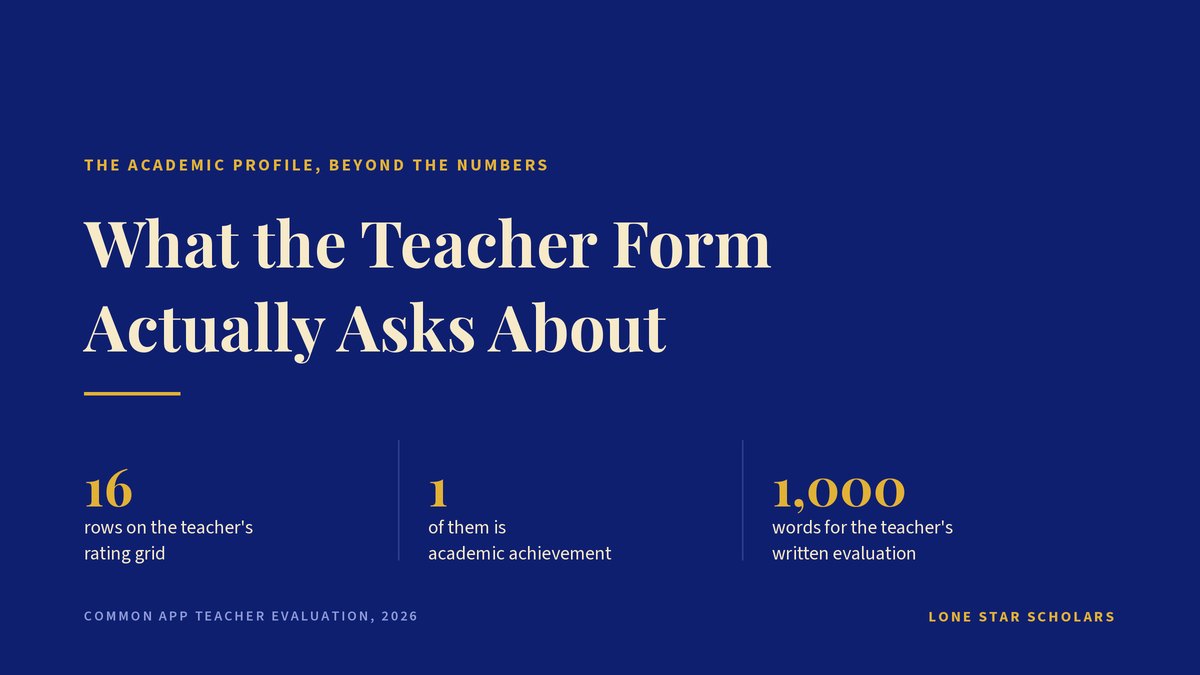
💡 TL;DR: The Common App form your student's teachers fill in this fall rates them on sixteen lines, from "Intellectual promise" to "Reaction to setbacks," on a scale whose top box is "One of the top few encountered in my career." One of those lines is academic achievement. The counselor's form adds a box judging whether the schedule was the "most demanding" at your school. The part of the academic profile that separates strong transcripts from each other is written by other people, and it is built in a classroom long before anyone asks for a letter.
Last week we read Harvard's Common Data Set line by line and found that the GPA, class rank and score benchmarks families plan against were mostly reconstructed by third parties. That post covered the numbers. It left out the half of the academic profile that is not a number at all.
Every selective university reads a transcript next to forms written by the student's teachers and counselor. Those forms are public. We pulled the 2026 versions of the Common App Teacher Evaluation and School Report, read them against what the colleges themselves publish about what they look for, and checked one Texas graduation rule that matters more than most families realize.
The teacher form has sixteen lines, and grades are one of them
The Common App Teacher Evaluation opens with a grid. The stem reads "Compared to other students in their class, how do you rate this student in terms of:" and the sixteen rows, in order, are academic achievements, intellectual promise, quality of writing, creative thought, productive discussion, faculty respect, disciplined habits, maturity, motivation, leadership, integrity, reaction to setbacks, concern for others, self confidence, initiative, and overall.
The columns run from "Below average" through "Excellent (top 10%)" and "Outstanding (top 5%)" to a last column: "One of the top few encountered in my career." There is also a "No basis" column for a teacher who cannot judge a row.
Read the rows as a description of a student and grades take up one line. A student who earns a 100 in AP Chemistry has earned the first row. Most of the other fifteen are about how the 100 was earned: whether the student moved the class's thinking forward ("Productive discussion"), brought ideas the teacher had not handed them ("Creative thought"), and what happened after the one exam that went badly ("Reaction to setbacks").
Below the grid the teacher answers "What are the first words that come to your mind to describe this student?" and attaches an evaluation of up to 1,000 words that, in the form's own words, "will help colleges differentiate this student from others." Common App's writing guide for recommenders tells teachers to use what they have seen in class "to depict the student as a scholar," and spells out what that looks like: a "desire to engage with the learning process beyond what's expected of the class," the "willingness to be challenged," and the "reaction to academic setbacks such as failing a test or not understanding a concept."
The quiet student with perfect scores can top one row and leave the teacher with nothing to write in the other fifteen. That is not a character flaw, and it cannot be fixed in October of senior year. It gets fixed in class, over months, in front of the teacher who will eventually be asked.
The counselor rates the schedule, not just the grades
The School Report, which the counselor fills in, carries the question that turns "rigor in context" from advice into a checkbox: "In comparison with other college preparatory students at your school, the student's course selection is:" The options are "Less than demanding," "Average," "Demanding," "Very demanding," "Most demanding" and "Prefer not to respond."
The comparison is local, and the form says so. A student is not measured against a national AP count. They are measured against the most demanding path their own school offered, by the person who knows what that path was. The counselor also fills in a shorter version of the teacher grid (academic achievements, extracurricular accomplishments, personal qualities and character, overall) and ends with "I recommend this student:" on a scale from "With reservation" to "Enthusiastically."
The same form asks the counselor to mark which grades are on the transcript being sent, from "Final junior year grades" through the first semester of senior year. Senior year is on the form. A schedule that got lighter after junior year shows up twice: once in the course list, and again in the rigor box.
Breadth across the core is published, and Texas asks for less
On this point the colleges are unusually specific.
Harvard describes "an ideal four-year preparatory program" as "four years of English, with extensive practice in writing; four years of math; four years of science: biology, chemistry, physics, and an advanced course in one of these subjects; three years of history, including American and European history; and four years of one foreign language." It adds that "the strongest applicants take the most rigorous secondary school curricula available to them."
Princeton lists four years of English, four of mathematics, four years of one language, at least two years of laboratory science and at least two of history, and says plainly that its list "is not a list of admission requirements."
Neither list is a requirement. Both describe a student who did not drop a core subject to make room for the intended major.
Now set that next to Texas. Under the rule that defines the state's Foundation High School Program, 19 Texas Administrative Code §74.12, the language requirement is two credits, and those two credits can be "two credits in computer programming languages," with AP Computer Science Principles and AP Computer Science A both on the list. A Texas student can earn a full diploma without taking a world language at all. For a student headed toward computer science, that can look efficient. Next to Harvard's "four years of one foreign language," it reads as a core subject that stopped early.
One course is not a reason to panic. It is a reason to look at the four-year plan as a whole, English, math, science, history and a language, before the junior and senior schedules lock in.
The grade trend is read, and colleges say how
The forgiveness families hope for after a rough freshman year is real, and at least one college puts it in writing. Stanford says: "We consider grade 9 a transition year and will focus our review on grades 10 and 11 as well as on your final year grades and program of study." Yale calls the transcript "the single most important document in your application," because it "tells us a great deal about your academic drive and performance over time." The University of Washington lists "demonstrating a positive grade trend" and "taking full advantage of the senior year" among the things it reviews.
Look at the shape of that. A trend can run in either direction, and it has a last data point. The year that gets the least forgiveness is the final one.
"Intellectual vitality" is a heading on Stanford's website
Families often hear the phrase from consultants, but consultants did not invent it. It is a section heading on Stanford's application overview: "Stanford students are brimming with curiosity, openness, and imagination." Stanford continues, "Through your application, we hope to learn about your intellectual horizons." It then asks for that directly, in a 100-to-250-word essay: "Reflect on an idea or experience that makes you genuinely excited about learning."
Other schools say the same thing in other words. MIT's list of what it looks for includes "Initiative," "Risk-taking," "Hands-on creativity" and "Intensity, curiosity, and excitement," and adds a sentence worth putting on the refrigerator: "We don't expect applicants to do a million things. Choose quality over quantity." Yale says two questions guide its process: "Who is likely to make the most of Yale's resources?" and "Who will contribute most significantly to the Yale community?"
Princeton goes furthest. It requires a graded written paper "from an academic course in English, social studies or history, from the last three years of secondary school," submitted with the teacher's grade and comments. That is a real piece of classroom work, and the admissions office reads it as it was handed in. A senior applying to Princeton this fall should choose that paper now, not the night before the deadline.
What Harvard's readers were once told separates a 1 from a 2
One of the most specific public descriptions of this distinction is old, and it has to be read as old. During the 2018 trial in Students for Fair Admissions v. Harvard, Harvard's reading procedures for the Class of 2023 became a trial exhibit, and the Harvard Crimson published them. They describe the academic rating Harvard's readers assigned to applicants.
A 2 was "Magna potential. Excellent student with top grades," along with high scores and "possible local, regional or national level recognition in academic competitions."
A 1 was "Summa potential. Genuine scholar; near-perfect scores and grades (in most cases combined with unusual creativity and possible evidence of original scholarship, often substantiated by our faculty or other academic mentors.)"
That document is eight years old. It refers to SAT Subject Tests, which no longer exist, and it predates the 2023 Supreme Court ruling that reshaped admissions. It is not Harvard's current rubric and should not be read as one. Its structure still teaches something: in that rubric, the difference between a 2 and a 1 was never grades. Both ratings assumed them. What separated the two was creativity and original work, confirmed by someone other than the student.
Competitions and research count because someone else checked
That is what the things families file under "beyond the classroom" are really for. An Olympiad qualifier, a regional science fair placement, a juried writing award, a research paper a mentor can speak to: each one is a judgment made by someone outside the student's own school. The Common App has room for up to five academic honors, each listed with "the level of recognition you received," and the forms above give teachers and mentors a place to say what they saw.
Volume does not help here, for the reason MIT gives. One piece of work that held up under outside review says more than a page of participation certificates. We looked at what that outside review looks like up close in our post on TJAS 2026, where 82 of the 100 accepted presenters came from North Texas.
What to do this month
- Seniors: give each recommender something specific. Teachers fill in sixteen rows and up to 1,000 words for many students at once. A one-page note listing the courses they taught you, one moment from their class you are proud of, and one time something went wrong and what you did next gives them material for the rows that are not grades.
- Seniors applying to Princeton: choose the graded paper now. It should come from English, social studies or history, from the last three years, with the grade and comments visible.
- Check the four-year plan against the core. Lay out English, math, science, history and language by year. If one stops after two years, decide on purpose whether that is the right call, especially when computer science credits have replaced a language.
- Sophomores and juniors: the recommendation is being written now. The teacher who writes it is probably in front of your student this semester. "Productive discussion" and "Intellectual promise" do not come from a brag sheet. They come from what happens in the room.
- Read the two forms yourself. The Teacher Evaluation and the School Report are a few pages each. Fifteen minutes with them will change how your student thinks about class participation.
The bottom line
Top universities do expect the transcript you have heard about: the hardest path the school offers, strong grades in every core subject, and a record that improves rather than fades. That part is real, and our previous post walks through what the colleges actually publish about it.
What separates strong transcripts from each other is mostly written by other people: the teacher who rated "Intellectual promise," the counselor who checked "Most demanding," the mentor who can say the work was original. None of it can be put together in the fall of senior year. All of it can be built, one class at a time, by a student who is genuinely curious in a room where someone is paying attention.
💛 Want a second read on where your student stands? At Lone Star Scholars in Frisco we look at the transcript, the four-year plan and the college list together, and work out what is still changeable in the time remaining. Reach out and we will start from the forms colleges will actually see. Students who want academic work a mentor can genuinely vouch for can also join the interest list for our 2027 Summer Research Program.
Sources: The Common Application, Teacher Evaluation and School Report sample forms (© 2026, as hosted by Harvard College); Common App, Writing Guide for Counselors and Teachers (2025) and first-year applicant materials checklist (2025); Harvard College admissions FAQ on secondary school course preparation; Princeton University Office of Admission, Before You Apply and Graded Written Paper pages; Stanford Undergraduate Admission, application overview and first-year application pages (updated July 21, 2026); MIT Admissions, What We Look For; Yale Undergraduate Admissions, What Yale Looks For; University of Washington, first-year holistic review; 19 Texas Administrative Code §74.12, as amended effective August 1, 2025; Harvard College Reading Procedures for the Class of 2023, SFFA v. Harvard trial exhibit P633, as published by the Harvard Crimson on October 29, 2018. All retrieved October 4, 2026.
Ready to Get Started?
Schedule a free consultation to discuss your student's goals and create a personalized plan.
Book Free Consultation