💡 TL;DR: The Common App gives you three fields per activity — a 50-character position, a 100-character organization name, and a 150-character description. A lot of students waste the 150 by repeating the first two and by reporting hours the form already collects elsewhere. Strip both out and you get roughly a third of your space back for what actually persuades: what you did and what changed because of it.
Many students spend weeks on the personal statement and fill in the activity list the night before the deadline. That order is backwards for a simple reason: the essay is one story, and the activity list is ten. It is the only place in the application where a reader sees the whole shape of four years at once.
Importantly, a lot of students write the same six entries again and again — National Honor Society, a sport, a weekly volunteer shift, a club membership, a summer job, a summer program. There is nothing wrong with any of them. The problem is that they are usually written as job descriptions, and a job description is the one thing 150 characters cannot afford.
This post is about the writing, not the choosing. If you are still deciding what to commit to, start with what the NACAC data really says about extracurriculars and the case for sustained impact over activity soup. This one assumes the activities already exist and you have to describe them.
What the Section Actually Asks For
Per Common App's own guidance, you may enter up to 10 activities. You are not expected to use all 10. Common App's wording is worth repeating exactly: "Focus on what activities can best tell that story and not on the number you're reporting."
For each entry you provide:
- Activity type, from a dropdown. If nothing fits, pick "other club/activity."
- Position/Leadership description — 50 characters.
- Organization name — 100 characters.
- Activity details, honors won, and accomplishments — 150 characters.
- Years of participation, plus hours per week and weeks per year.
Two things follow from that list, and almost nobody acts on either.
The 150 is your third field, not your only one. Your title is already on screen. So is the organization. Anything you repeat there is dead weight.
The time commitment is already reported. Hours per week and weeks per year are separate fields. Common App makes this explicit in its own worked example, where the edited version drops the time spent "because that information is reported elsewhere in the section."
Separately, the application gives you up to 5 academic honors, each with a title, the year, and the level of recognition. An award that belongs there does not need to eat characters in an activity description.
The Single Biggest Waste of Space
Here is a description that looks strong and is not:
- "Debate Club vice president; led weekly prep, coached 12 members, organized 2 tournaments, helped team reach state finals." (121 characters)
"Debate Club" is already in the organization field. "Vice president" is already in the position field. Twenty-eight characters, counting the space, are spent telling the reader something they read two seconds ago. Reclaim them:
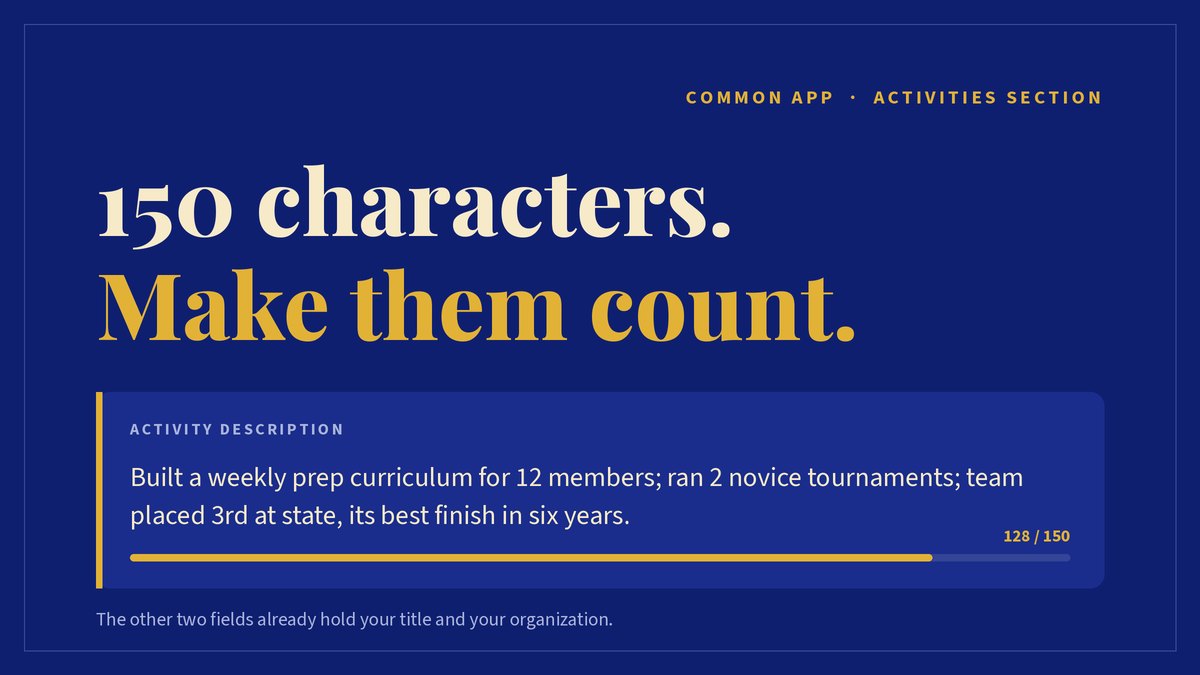
- "Built a weekly prep curriculum for 12 members; ran 2 novice tournaments; team placed 3rd at state, its best finish in six years." (128 characters)
Same field, same limit, and now the entry contains a curriculum, a novice program, and a result with historical context. Nothing was cut. Something was added.
Do the same with hours. "Volunteered 120+ hours; packed and distributed 8,000 meals" spends 24 characters on a number the form collects in a dedicated field. "Packed and distributed 8,000 meals" keeps the part a reader cannot get anywhere else.
The Pattern: Verb, Scope, Result
Every strong description does the same three things. It opens with a past-tense action verb, gives the scope that makes the action legible, and closes with something that happened. Led, founded, designed, built, analyzed, trained, launched, coordinated, mentored, rebuilt, streamlined.
Weak entries describe what the activity is. Strong entries describe what you did and what changed. Six comparisons:
Sports. "Member of varsity soccer team" tells a reader nothing they did not assume. Compare: "Ran preseason conditioning for a 22-player roster; mentored 4 underclassmen into starting roles; team reached its first regional final since 2019." (146 characters)
Volunteering. "Helped at local food bank" is forgettable. Compare: "Packed and distributed 8,000 meals; rebuilt the intake line and cut average wait 25%; trained 6 new volunteers on the revised process." (134 characters)
Work. Vague duties waste the limit. Compare: "Scheduled and supervised 6 staff per shift; ran cash reconciliation and closing; redesigned prep sheets and cut weekly food waste." (130 characters)
Research. "Assisted in a biology lab" signals presence, not contribution. Compare: "Analyzed tumor-cell viability across 200+ assays; maintained cultures and reagent logs; co-presented results at a regional symposium." (133 characters)
Clubs. Passive membership is the most common missed opportunity. Compare: "Founded and ran a 12-member novice program; wrote the prep curriculum still in use; hosted 2 tournaments for 60 visiting students." (130 characters)
Arts. "Performed in school plays" is generic. Compare: "Directed and edited 5 short films; ran a 9-person cast and crew; submitted to 3 festivals and won Best Student Film at a regional showcase." (139 characters)
A Real Before and After
Students rarely start under the limit. A first draft usually looks like this:
- "For the past two years I have been responsible for helping to organize various club events, and I also assisted the president with managing multiple team projects throughout the school year." (190 characters)
Forty characters over, and the overage is entirely in throat-clearing: "I have been responsible for," "helping to," "various," "multiple," "throughout the school year." Every one of those can go.
- "Planned the club's event calendar; ran 6 project teams alongside the president; organized 3 fundraisers that funded our competition travel." (139 characters)
The revision is shorter and says more, because "various events" became a calendar and "multiple team projects" became six of them with a purpose attached. The limit is not the enemy. It is the thing that forces you to name what you actually did.
Order Is a Signal, Not an Accident
You choose the order your activities appear in, and you can change it any time before you submit. Readers start at the top and their attention is not evenly distributed, so slot one should be the activity that best shows depth, growth and contribution — not the one with the grandest title or the most hours.
A student who built a tutoring program over three years leads with that, not with a sport played casually for one season. Think of the list as a portrait: two to four activities with real progression, surrounded by entries that add dimension without diluting the picture. That is the same argument we made in the extracurricular myth, applied to layout instead of strategy.
Why Research Entries Read Differently
Most of a reader's stack contains the same entries. A research entry is unusual because it is checkable. "Showed leadership" is an assertion. A manuscript, a poster and a conference presentation are artifacts with dates, co-authors and a venue attached. The claim survives without the reader having to take your word for it.
That is the entry our summer scholars finish with. Our Intensive Summer Research Program runs 10 weeks, caps the cohort at seven, and pairs each student with an MD or PhD mentor for weekly one-on-one sessions. Students design a study on federal health data — BRFSS, NHANES, CDC WONDER, AHRQ MEPS — and finish with three things: a preprint-ready manuscript, a professional research poster, and a 12-minute symposium talk.
You can see what that looks like at our 2026 Summer Research Symposium, where the cohort presented original public-health findings to families, mentors and the community.
On the activity list, it reads like this:
- "Analyzed CDC survey data on sleep and mental health across 4 states; wrote a preprint-ready manuscript; gave a 12-min talk at a research symposium." (147 characters)
If that is the kind of entry your student wants to be writing next fall, check our program page in spring 2027 for the next cohort's dates.
Eight Templates, Filled In
Templates are the floor, not the ceiling. A bracketed template always fits; the filled version is what has to clear 150, so each one below is shown both ways with a real count. Write yours, then count the characters before you paste.
Research. "Analyzed [dataset] to test [question]; ran [#] models; co-authored [output] and presented at [venue]."
- Filled: "Analyzed NHANES data to test diet-diabetes links in teens; ran 18 regression models; co-authored a preprint and presented at a state symposium." (143 characters)
Club founder. "Founded [club]; grew to [#] members; built [thing]; [result]."
- Filled: "Founded the school's first robotics club; grew it to 40 members in one year; ran 12 build nights; qualified two teams for the state meet." (137 characters)
Student government. "Represented [#] students; wrote and passed [#] proposals; ran [event] for [#] attendees."
- Filled: "Represented 1,800 students; wrote and passed 4 proposals including a later first-bell start; ran a spring service fair for 600 attendees." (137 characters)
Tutoring. "Tutored [#] students in [subjects]; built [materials]; [outcome]."
- Filled: "Tutored 8 students in Algebra I and Geometry; built a problem bank now used by the whole program; all 8 passed the end-of-year exam." (132 characters)
Service project lead. "Led a [#]-person team; [built/delivered/served] [metric]; [measurable change]."
- Filled: "Led a 10-person team distributing groceries to 200+ families; rerouted the delivery schedule and cut missed drop-offs by half." (126 characters)
Sports captain. "Led [#]-player roster; introduced [practice/system]; team [result]."
- Filled: "Led a 22-player roster; introduced film review and a preseason conditioning block; team went 14-4 and reached the regional semifinal." (133 characters)
Part-time work. "Supervised [#] staff; handled [responsibility]; [improvement you made]."
- Filled: "Supervised 6 staff per shift at a family restaurant; handled closing and cash reconciliation; retrained the prep line to cut food waste." (136 characters)
Independent project. "Built [project] using [tools]; reached [#] users; [recognition or result]."
- Filled: "Built a bus-tracking app for my campus using React and the district feed; reached 900 weekly users; presented it to the transportation office." (142 characters)
Use the structure, then push past it. The best descriptions contain a detail nobody else could have written.
One Last Thing
If an activity genuinely cannot be compressed — a family responsibility, an unusual job, a project that needs context — Common App provides the Additional Information question in the Writing section for exactly that. Use it sparingly. Most entries do not need it; they need the title and the hours taken out.
The activity list is not a résumé. It is ten short arguments about what you built and who you were while building it. Write it with the same intention you bring to the essay, and count every character.
Families in Frisco and Collin County who want to build an entry like the research one above rather than polish what already exists can talk to our team about whether the summer research program fits their student's timeline.
Ready to Get Started?
Schedule a free consultation to discuss your student's goals and create a personalized plan.
Book Free Consultation