Ask ChatGPT, Gemini, or Claude to plan high school for a rising sophomore, and in about a minute you'll have one. Courses by year. Two clubs to grow into leadership roles. A research project idea. A list of summer programs. An SAT timeline. It reads as if a counselor wrote it, and it's tailored to whatever you typed in.
So it's fair to ask whether anyone still needs a college counselor.
Our answer will sound self-serving coming from a counseling practice, so we'll lay out the reasoning and you can judge it. We think students need a mentor more now than they did before AI, not less. Not necessarily a paid one. But someone.
Everyone got the same upgrade
A student who plans with AI often feels they've found an edge. They haven't, because the student sitting next to them in AP Chemistry has the same tools.
The general-purpose assistants are free or about $20 a month. Many of the specialized apps for admissions, research, and high school planning, most of them paid, are built on top of the same handful of models. Ask similar models similar questions and you get similar answers.
So the plans start to look alike: the same kinds of research projects, the same member-to-officer arc in the same clubs, the same summer programs. We saw the same thing happen to essays last cycle, when AI-polished essays started to sound the same and the ones that stood out were the ones that sounded like a real person.
When everyone gets the same upgrade, the bar moves and nobody ends up ahead. What still sets a student apart is what no plan can contain: what they actually do with it over the next two years.
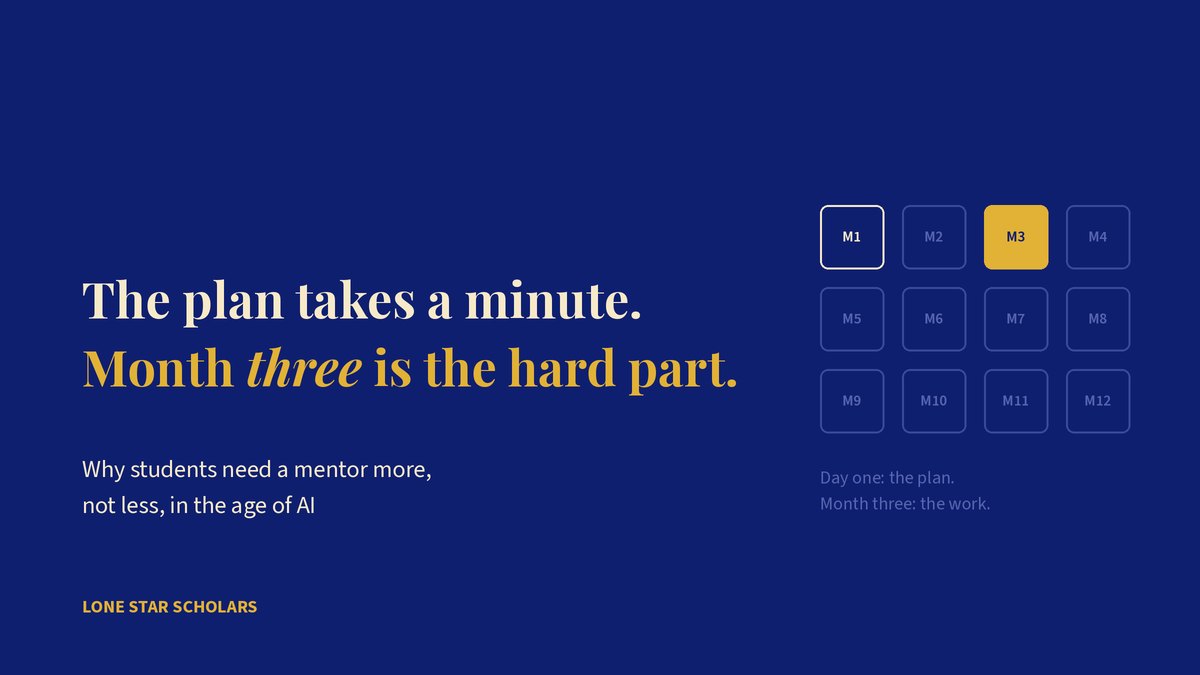
The plan isn't the hard part. Month three is.
An AI-generated plan works on day one. The trouble starts a few weeks or a few months in.
- The research project stalls. The data doesn't show what the student hoped, or the method they picked doesn't work, and they don't know the field well enough to tell whether it can be fixed. They ask the AI, get a confident answer that doesn't quite fit, try it, and come back. Without real knowledge of the field, they can't tell when the AI is wrong, so they go around in circles.
- The club gets complicated. An officer election, a teammate who doesn't pull their weight, a sponsor with different ideas. These are problems with people, and the AI has never met any of them.
- The doubt arrives. "Do I actually like this?" It's hard for a fifteen-year-old to tell whether that's a real mismatch or the ordinary slump that hits the middle of almost every long project.
What happens next is the real risk
The easy move is to drop the idea, open a new chat, and ask for a different project or a fresh plan for the rest of high school. A new plan feels like progress. It's the opposite.
As we wrote last week, most meaningful activities take time before they pay off. Every restart puts that clock back to zero. Plan-hopping is how a student reaches junior year with three half-finished projects and nothing that got far enough to matter.
Things getting hard isn't a sign the plan was wrong. Almost anything worth putting on an application has a stretch where the student doesn't want to do it anymore. Getting through that stretch is what colleges eventually see.
What a mentor does in that moment
This is where a person matters more than a better prompt.
A mentor can tell the slump from a real mismatch, because they've watched other students go through the same stretch. They can say "you've got this" and mean it, because they've seen what this student has already done. They can help with the practical part too: who to email, how to rescue the analysis, how to talk to the club sponsor.
And a mentor sees more than what the student says they want. AI knows what you tell it. A good mentor has watched dozens of students and has a sense of what a kid like yours can become, sometimes before the kid does.
Someone also has to say no
Saying no is the other half of the job, and we made the longer case for it in our last post. Capable students get offers: a new club, an officer role, a "research internship" from a parent group chat. Each sounds good on its own. Taken together, a pile of commitments that don't connect to each other can hurt an application rather than help it.
It's hard for a student to say no to their own opportunities. And an AI, asked "should I take this leadership role?", will usually find good reasons to say yes. It takes someone outside the situation to say "don't do this." We say it to nearly every student we work with.
The SAT retake we often talk students out of
A common case: a student has a 1520 and wants to spend two or three more months preparing to push it higher.
Here is where 1520 sits, according to the most recent Common Data Set each school publishes. The ranges below are the middle 50% of enrolled first-year students who submitted an SAT score:
- Dartmouth (2025–26): 1440 to 1550, median 1520
- Yale (2025–26): 1480 to 1560, median 1540
- Cornell (2024–25): 1510 to 1560, median 1540
- MIT (2025–26): 1520 to 1570, median 1550
At all four, 1520 is inside the middle range. At most schools a 1520 won't be the reason a student is turned down. Two or three months, meanwhile, is a lot of time. It's long enough to finish a research project, draft and redraft the main essay, or take the one activity that matters to the next level.
There is an exception, and it's a real one. At MIT, 1520 is the 25th percentile, which means most of the class scored higher. If a student's list is heavy with schools like that, and everything else in the application is strong enough that the score becomes the one number that looks out of place, a retake can be worth it. That's a judgment about this student and this list. It isn't a rule, and it's exactly the kind of call that's hard to make about your own child.
Telling a family "don't retake" is a responsibility. If we're wrong, we own it. That's part of the job.
That someone doesn't have to be us
Everything above is an argument for a mentor, not for a paid counselor. That someone can be a parent, a teacher, a school counselor, a coach, an older student, or a volunteer from the community.
What matters is that they know the student, they'll still be there in month three, they've seen enough students to tell a slump from a mismatch, and they're willing to say no.
Keep using AI, too. It's good at a first draft of a plan, at explaining how something works, and at answering questions at 11 p.m. Use it for what it's good at, and get a person for the rest.
Where we come in
At Lone Star Scholars, most of our work happens after the plan is written. We stay with students through the stalled project, the club problem, the "do I even like this?" conversation, and the no.
Our Summer Research Program works the same way: ten weeks on one question, using real CDC data, with mentors there when the analysis goes wrong, ending in one finished manuscript.
If your child already has a plan from AI and you're wondering who will help them stick with it, book a free consultation.
Ready to Get Started?
Schedule a free consultation to discuss your student's goals and create a personalized plan.
Book Free Consultation