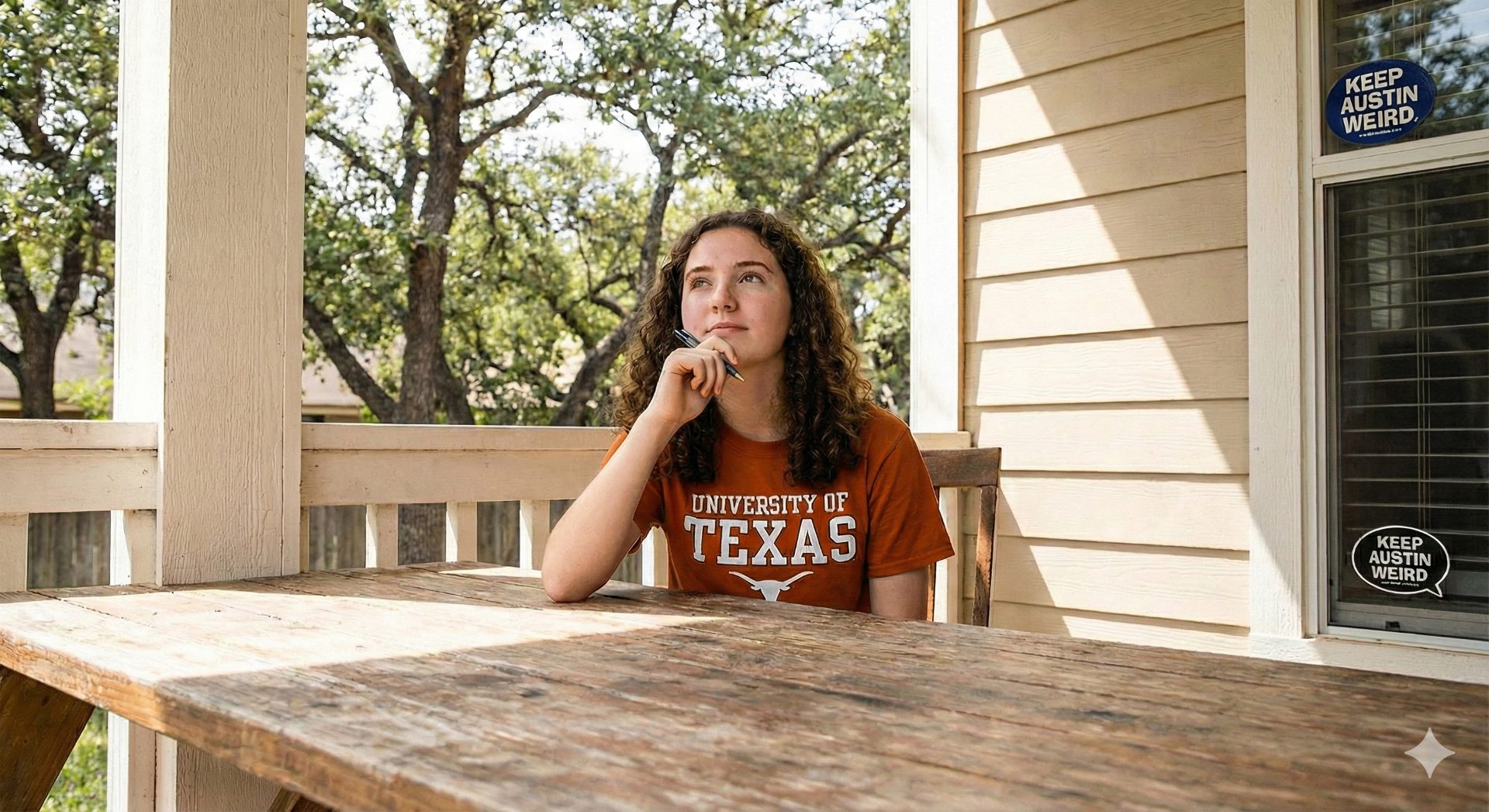
Picture a sophomore at Independence High. Monday is robotics. Tuesday is HOSA. Wednesday is a "virtual research internship" her mom found through a parent group chat. Thursday is DECA prep. Saturdays are a coding class in Plano, and she has two summer programs lined up already.
She's busy, capable, and working hard. Two years from now, when she opens the Common App's activities section, she'll fill every one of the ten slots.
The problem is that none of those ten entries will stand out.
This post covers two ideas we keep running into with families across Frisco, Plano, Prosper, and Allen. They sound like opposites, but they come from the same place.
Part 1: Why more is less
How the list gets so long
Usually it starts with FOMO.
A parent hears that a classmate's kid joined a new research program, or that a club at Centennial just won state, or that a friend's daughter landed a summer internship. Every new opportunity sounds like one your child shouldn't miss. So you sign up for this one, then that one, and then one more.
This comes from a good place. Parents in Collin County are informed and paying attention, and they want their kids to have every option. But each new commitment takes time from the ones your child already has.
What spreading thin actually costs
Most meaningful activities take time before they pay off. A research project needs time for the analysis to go wrong and get fixed. A competition needs time for the second and third attempt, which is usually where students improve. A club needs time before a student moves from member to the person who builds something new.
When a student has eight commitments, each one gets a fraction of that time. Things start but don't finish. Projects stop at "participated." Nothing gets far enough to compete seriously, get better, or reach a strong conclusion.
Even students who can handle the load rarely do their best work on any of it. They keep up, but they don't go deep.
On an application, this produces a long list of activities that don't add up to a clear picture of who the student is.
Last month we looked at the TJAS 2026 presenter list, where 82 of 100 students came from North Texas. In a region like ours, doing a lot of things is normal. What still stands out is doing one thing fully: the project that's finished, the result that's public, the club you actually changed.
A quick test for any activity
Before adding something new, ask three questions:
- Will this get finished? Is there a clear end point, such as a manuscript, a competition result, or a product, that your child can realistically reach?
- Can your child explain why they chose it? "My friend was doing it" is a reason to try something, not a reason to keep doing it.
- What will it replace? Time is limited. Every yes is a no to something else, usually something your child is already doing.
If an activity fails all three, dropping it is often the best thing you can do for your child's application.
Part 2: Why free is expensive
AI really does know a lot
Let's be honest about this. Tools like ChatGPT and Claude can explain how UT Austin's automatic admission works, compare TAMU majors, list summer programs, and outline an essay strategy at any hour for free. On factual information, they often know about as much as an experienced counselor.
So it's reasonable for a parent to wonder why they should pay for advice that seems to be free.
Information isn't the hard part
Ask an AI how to build a strong high school profile and you'll get a thoughtful answer with fifteen or twenty strategies. All of them are reasonable, and many are good.
Then your 15-year-old has to decide which ones to pursue.
That's the hard part, and it's where AI hits its limits. It answers the question you asked, and it knows only what you told it in that conversation. It hasn't watched your child light up while explaining a math problem or lose interest halfway through a coding course. It can't tell you that the activity your kid enjoys most is the one worth building around. Six months from now, it won't notice that the plan has drifted and needs to change.
Most adults find it hard to know what they're naturally good at. For a teenager, it's even harder. Picking a strategy, matching activities to real strengths, and adjusting as junior year changes things all take judgment, and judgment depends on knowing the student.
Where the cost shows up
"Free" becomes expensive slowly. A summer spent on the wrong program. Three projects that don't connect to each other. A junior year built around strategies that didn't fit the student. None of it feels like a mistake while it's happening. It shows up later, when the application is due and there's no time to start over.
High school only happens once, and you can't redo sophomore year.
Who really doesn't need help
Not every student needs a counselor. Some are very driven and know what they love. Some have an older sibling who already went through the process, and the parents learned along the way. If that describes your family, the free tools plus your own experience may be enough.
For many students, though, especially those aiming at selective schools without a clear sense of direction, assuming they can manage on their own is the costly choice.
The common thread
Both problems come from abundance. Today's students have more opportunities, more information, and more options than any generation before them. More options make choosing well more important, and harder.
The students who do well in Frisco, Plano, and across Collin County usually aren't the ones doing the most. They're the ones who chose carefully, went deep, and adjusted when something wasn't working.
Where we come in
At Lone Star Scholars, we help families choose fewer things more carefully. We identify where a student's real strengths are, build a plan around them, and adjust the plan as the student changes.
Our Summer Research Program follows the same idea: ten weeks on one question, using real CDC data, ending in one finished manuscript.
If your child's calendar looks like the one at the top of this post, or your browser has twenty open tabs of AI-generated strategies, book a free consultation. We'll help you work out what to keep, what to drop, and what's worth building.
Ready to Get Started?
Schedule a free consultation to discuss your student's goals and create a personalized plan.
Book Free Consultation