Three Lone Star Scholars are going to College Station.
Three of our Summer Research Program students each had their work accepted for the Texas Junior Academy of Science (TJAS) annual meeting, October 8–9 at Texas A&M. All three built their projects this summer from real CDC data: sleep and self-reported health, sleep and cognitive decline in adults over 45, and cancer screening gaps among Asian American women. They ran the models and wrote the manuscripts themselves. We're very proud of them.
We're just as proud of the work that didn't get in. Not every project we sent forward this year was selected. That doesn't make it less serious, and the thinking behind it doesn't go away because of one committee's decision. We fully expect to see that work presented and published — this year or next.
After we celebrated, we read the full presenter list, and one thing stood out.
What the List Shows
TJAS published 100 accepted presenters for 2026. We sorted them by school:
- 82 of the 100 come from Dallas–Fort Worth.
- Plano ISD's four high schools account for 45. That's Plano West, Plano East, Plano Senior, and Jasper.
- Plano West Senior High has 23 presenters on its own. That is more than Houston, Austin, and Bryan/College Station have combined, which is 13.
- The Texas Academy of Mathematics and Science (TAMS) in Denton has 22. TAMS takes students from across the state, so it is fair to set it aside. Without TAMS, DFW still holds 60 of the remaining 78 spots, or about 77%.
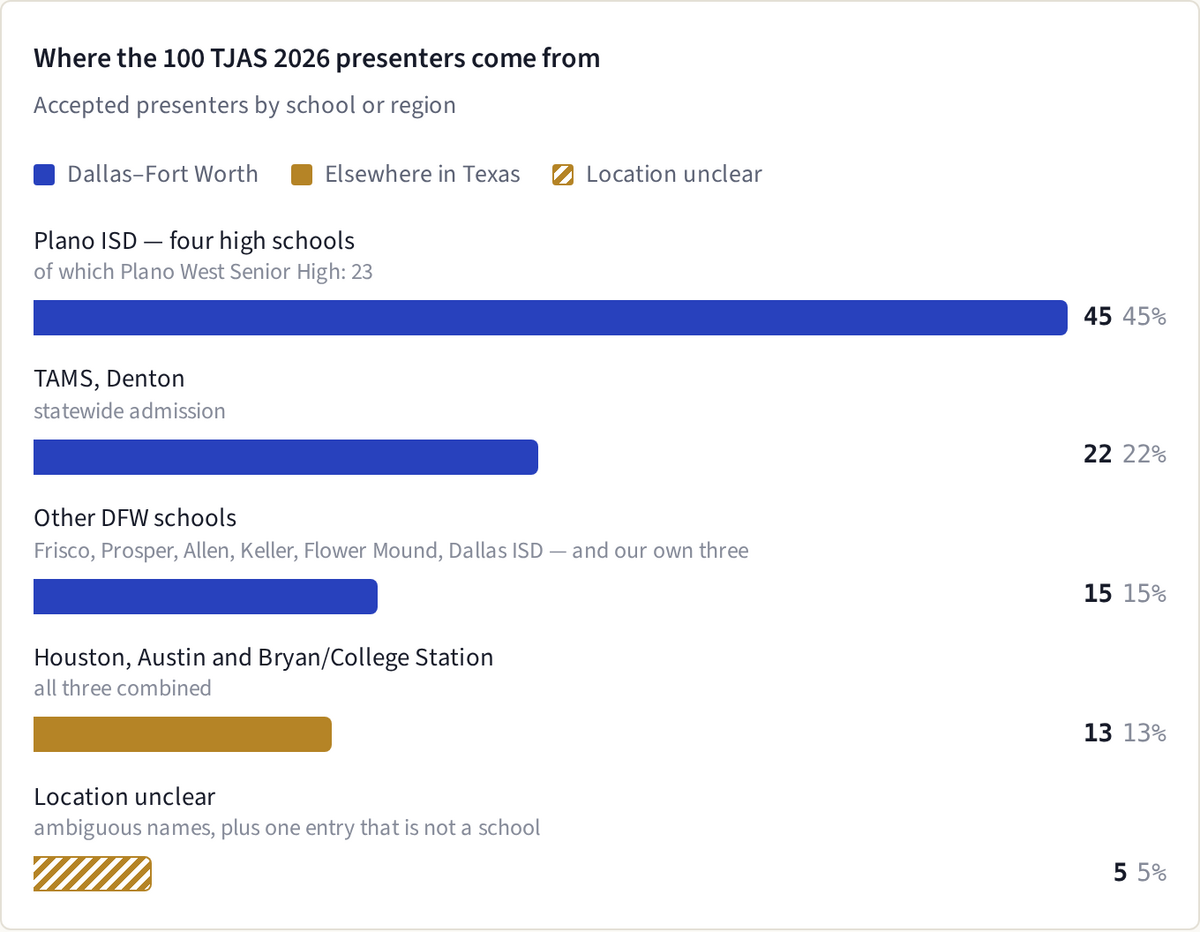
Our count comes from the public presentation schedule on the Texas A&M College of Arts & Sciences Outreach site, re-checked on September 24, 2026. We assigned schools with common names — a "Central High School," for example — to "location unclear" rather than guessing, along with one entry that is an organization rather than a school. Two presenters are listed under the University of North Texas; we counted those with Denton. Our own three students are inside the 15 for other DFW schools, and we have left them there rather than quietly removing ourselves from a count we are reporting on.
Frisco, Prosper, Allen, Keller, Flower Mound, and Dallas ISD's School of Science and Engineering are all on the list too. North Texas is strong in high school research. On a state stage, it is not close.
That is something to be proud of. For the individual student applying to college from here, it is also a problem.
Colleges Read You Next to Your Classmates
Selective colleges do not compare a Plano West senior to every applicant in the country. They read each application in the context of that student's high school: the courses the school offers, what is typical there, and what the other applicants from that school have done. Many offices assign readers by region, so the same person may read every application from your school, or your part of Collin County, in the same cycle.
Put that next to the numbers above.
If you are at a school where research is rare, a TJAS presentation says, "This student went well past what their environment offered." If you are at a school that sent 23 students to TJAS, the same line says, "This student did what a lot of strong students here do." It is still a real accomplishment, and it still belongs on your application. It just stands out less.
This happens across most activities in Collin County. Research, USACO, AMC and AIME, DECA, HOSA, Science Olympiad, and dual credit at Collin College are all crowded here. When everyone around you is excellent, excellence becomes the baseline you are measured from.
Submissions More Than Doubled in One Year
Here is the part that surprised us most.
The TJAS organizing committee has indicated that submissions more than doubled compared to last year.
The acceptance list does not look like it doubled. Plano ISD reported 48 students accepted in 2025 and has 45 on this year's list. So if the number of spots stays about the same while applications double, getting in has become much harder in a single year. We have not confirmed the exact number of spots offered in each year, so treat that last step as our reading of the public numbers rather than a published figure.
We think this is about efficiency. Students have better tools than ever: AI coding assistants, free public datasets, open-access papers, and structured programs that shorten the path from "I am curious about this" to "here is a finished manuscript." A project that took a motivated junior a full year in 2022 can now be done over a summer.
That is great. But students are not using that extra efficiency to rest. They are using it to do more research, more competitions, more of everything.
Assume Everyone Else Got Faster Too
This is our main advice for students in Frisco, Plano, Allen, Prosper, and the surrounding area:
If you are doing more this year than last year, or more than your older sibling did two years ago, or more than the neighbor's kid did three years ago, assume everyone else is too.
Being more productive than your past self feels like progress, and in a real sense it is. But admissions compares you to other applicants, not to your past self. If the whole field gets faster, everyone ends up in about the same place relative to each other.
What can you do about it?
1. Compete on Your Question, Not Your Volume
Twenty-three polished machine-learning projects from one school start to look alike. What is hard to copy is a question that is clearly yours: something that came from where you live, your family, or something you noticed that other people missed. One of our projects this summer looked at cancer screening among Asian American women — a gap that shows up in the national data and in the community that student grew up in. That question could not have come from anyone else.
2. Go Deep Instead of Wide
Five projects are not better than one project you have pushed all the way: the analysis is sound, the limitations are clearly stated, and the manuscript can stand up to criticism. Depth is also easier to see when readers are comparing you with classmates.
3. Finish Things
A lot of this year's extra submissions will never become a preprint, a publication, or a second version. Getting a project to a finished, public form is still less common than you would expect.
4. Do Not Read One Decision as a Verdict
When submissions double, strong work gets turned down. That is arithmetic, not a judgment of the student who wrote it. The right move is to revise the project and submit it again, not to decide research is not for you.
The Takeaway
North Texas is one of the most competitive places in the country to be a high school student interested in science. For the region, that is excellent. For each student, it means your application will be read next to some of the strongest classmates anywhere.
That is not a reason to worry. It is a reason to plan more carefully: pick your questions deliberately, go deep, and do not assume that doing more automatically puts you ahead.
If you want help choosing a research question that is actually yours, or turning a finished project into something public, that is what our Summer Research Program is built for. You can also get in touch with any question about where to start.
Ready to Get Started?
Schedule a free consultation to discuss your student's goals and create a personalized plan.
Book Free Consultation