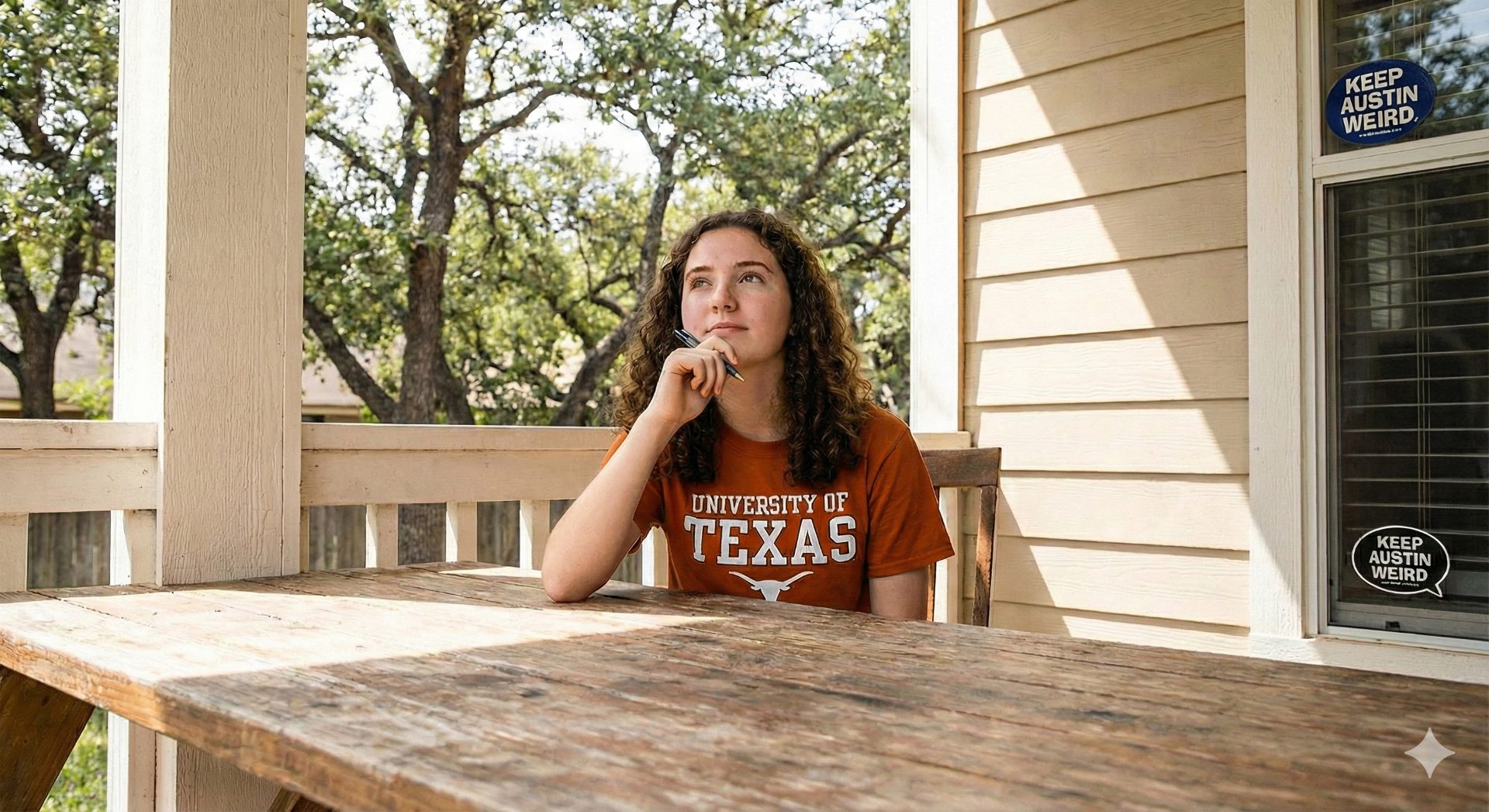
If you're a Frisco ISD sophomore right now, here's something no counseling office is going to tell you in those exact words: the summer between sophomore and junior year is the single most important stretch of unstructured time in your high school career.
Not the summer before senior year. That one's too late. Not the summer after eighth grade. That one's too early. This one. The ten weeks between June and August right before you walk into junior year.
Here's why — and what to actually do about it.
The Application Timeline Math Nobody Explains
Most parents in Plano, Prosper, and Frisco assume college applications are a senior-year thing. They're not. By the time a Texas student opens ApplyTexas in August of senior year, the application is mostly describing what they already did. The work is done. The stories are already written, whether the student realizes it or not.
Walk it backwards:
- Senior year fall: You're writing essays, hitting deadlines, finalizing your list.
- Junior year: You're taking your hardest courseload, prepping for SAT®/ACT®, and trying to lead the clubs you joined as an underclassman.
- Summer before junior year: This is the last meaningful block of time where you can start something new and have it look like a real, sustained commitment by application time.
That last point is the one most families miss. Admissions officers reading a senior-year application want to see depth — a multi-year arc, not a flurry of last-minute activity. A research project, internship, or independent initiative that begins the summer before junior year has 14+ months to mature before you hit submit. The same project started junior year summer? About two months. The same project started senior year? It looks exactly like what it is.
The "Narrative Window" Closes Faster Than You Think
Here's a way to think about it that we use a lot with our students: every applicant is telling a story whether they mean to or not. Holistic review at UT Austin (CNS, McCombs, Cockrell) and Texas A&M's competitive majors isn't a checklist — it's pattern recognition. Reviewers are asking, what is this student actually about?
The summer before junior year is when that pattern starts to become visible. Before this summer, your activities list is essentially "things a kid did." After this summer, it starts to look like "things a person who cares about X is doing."
✨ That shift is the entire game.
A few examples of what that looks like in practice for students we've worked with from Heritage, Centennial, and Reedy:
- A sophomore curious about medicine spends the summer learning R and analyzing CDC data on adolescent mental health trends. By junior year, she's drafting a manuscript. By senior year fall, she has a preprint posted and a recommendation from a research mentor who's watched her work for over a year.
- A student interested in finance launches a small dual-credit pathway through Collin College the summer before junior year, builds a personal-finance newsletter for classmates, and by application time has a clear "this kid lives and breathes this" trail.
- A rising junior who'd been doing competition math for years uses the summer to actually grind AMC 12 prep seriously, qualifies for AIME in the fall of junior year, and now has a math identity that's quantitatively documented.
None of these required a famous internship. None required parents with industry connections. They required time, direction, and starting early enough that the work could compound.
Why Junior Year Itself Is the Wrong Time to Start
Junior year in Frisco ISD is brutal. We don't need to convince any parent of this. AP Chemistry, AP US History, Pre-Cal or BC Calc, an AP language, plus an SAT® or ACT® prep schedule, plus whatever leadership role the student is stepping into. There is no slack.
Students who try to "start something meaningful" during junior year almost always end up doing one of two things:
- Adding it to an already-overloaded schedule and burning out by spring, which produces worse grades and a half-finished project.
- Doing it superficially — a one-week summer camp, a weekend hackathon, a single shadowing day — which is exactly the kind of activity that gets read as filler.
💡 The summer before junior year is the only time you have capacity and runway in the same window. Lose it, and you're choosing between depth and grades for the next two years.
What "Doing It Right" Actually Looks Like
A few principles we'd offer to any Collin County family thinking about this summer:
- Pick something you can sustain for 12+ months. Not a week-long camp. Not a $4,000 "pre-college program" that ends in July. Something with a runway. Research projects, independent writing, building a tool or product, a real internship, deep competition prep — these compound. Two-week experiences don't.
- Start before June 15th. Every week of June you spend "figuring it out" is a week that isn't going on the application. Have the plan locked before AP exams end in May.
- Get a mentor who'll still be there in February. A summer-only mentor is fine for skills. For a recommendation letter and a sustained project, you need someone who's watching you for at least a year.
- Make sure the artifact is real. A manuscript. A GitHub repo. A USAJMO score. A nonprofit that has actually served people. The thing you can point to that exists in the world.
A Note on Our Summer Research Program
This is genuinely why we built our Summer Research Program the way we did — 10 weeks (June 1 to August 9), real CDC datasets, students learning R and producing preprint-ready manuscripts, and mentorship that continues into the school year so the work actually shows up on senior-year applications as a sustained, year-plus arc.
It's the program we wished existed when we were watching brilliant Frisco ISD students do everything right academically and still end up with an activities list that looked like everyone else's.
If you're a sophomore (or the parent of one) thinking about how to use this summer, book a free 60-minute consultation and we'll help you map out what an authentic, sustainable junior-year-and-beyond narrative could look like — whether that involves our program or not. The worst outcome is reaching November of senior year and realizing the most important summer was the one you didn't plan for.
Planning for Summer 2027? Our winter planning guide for current sophomores has five things to do now and a month-by-month timeline from November to May.
Lone Star Scholars is based at 12800 Westridge Blvd., Ste 126 in Frisco, and works with high school families across Frisco ISD, Prosper ISD, Plano ISD, McKinney ISD, and the broader Collin County area.
Ready to Get Started?
Schedule a free consultation to discuss your student's goals and create a personalized plan.
Book Free Consultation