💡 TL;DR: Instagram rewards confidence and virality—not nuance or context. College admissions is complex and individual. Advice that fits into a 30-second reel is usually incomplete, oversimplified, or optimized for engagement rather than accuracy.
Many families have come to me this year with a similar question about summer planning: can you help us identify strong internship or research opportunities?
The question itself isn't surprising. What stands out is how consistently it comes up — across grade levels, from 8th grade to current juniors. There's often an assumption that somewhere there exists a well-curated list of impressive opportunities, and that accessing the right one might meaningfully change a student's trajectory.
That assumption is understandable. We live in an environment where information is packaged into compelling, scroll-stopping lists — "Top Programs," "Must-Do Internships," "Hidden Opportunities." Over time, it's easy to internalize the idea that success begins with finding the right list.
It's not unreasonable to expect that a college counselor would have one ready.
But the consistency of this request made me reflect on how much our expectations around college preparation may be shaped by the way information circulates today — quickly, efficiently, and often without context.
Curious about that dynamic, I decided to pose a simple question to ChatGPT:
✨ "Why is Instagram a bad source for college admissions advice?"
The response was surprisingly grounded. It highlighted how platforms like Instagram prioritize attention over depth, speed over nuance, and certainty over context. Please read all of it below.
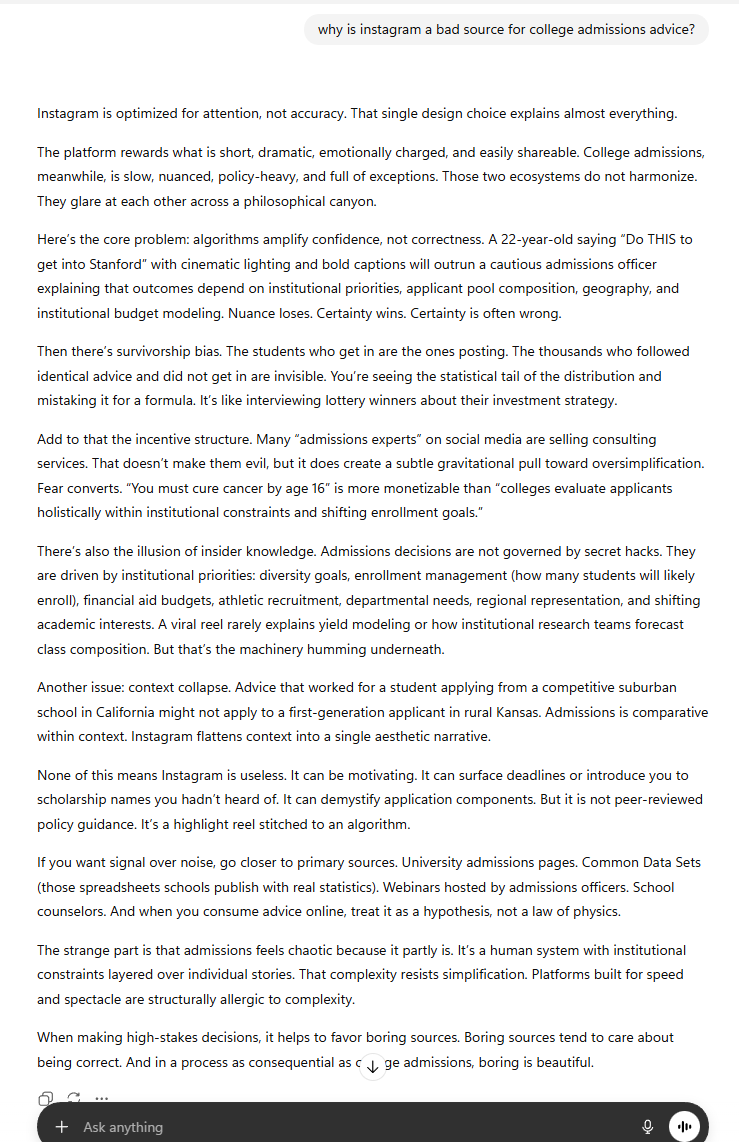
Click image to view full response.
## The Structural Problem
Instagram's algorithm amplifies what triggers emotion: urgency, fear, comparison, certainty.
College admissions doesn't operate that way. It is contextual. Institutional priorities shift. What works for one student does not automatically generalize to another.
When a reel confidently declares "always do this" or "never do that," it is usually compressing a complex system into something misleadingly simple.
## Virality vs. Validity
Responsible admissions advice often sounds like: "It depends."
That phrase doesn't trend. It doesn't panic parents. It doesn't promise hacks. But it reflects reality.
## The Psychological Cost
Social media collapses thousands of students into one endless comparison feed. You see outcomes without context. Acceptances without rejections. Curated highlights without trade-offs.
Students start optimizing for optics instead of growth. That is rarely a winning long-term strategy.
## The Bottom Line
Instagram is not inherently harmful. But it is structurally unsuited for nuanced admissions strategy. College applications reward sustained depth, thoughtful choices, and self-awareness — not viral frameworks.
💛 Need thoughtful, individualized guidance? At Lone Star Scholars, we focus on strategy grounded in data, context, and long-term development—not soundbites.
Ready to Get Started?
Schedule a free consultation to discuss your student's goals and create a personalized plan.
Book Free Consultation