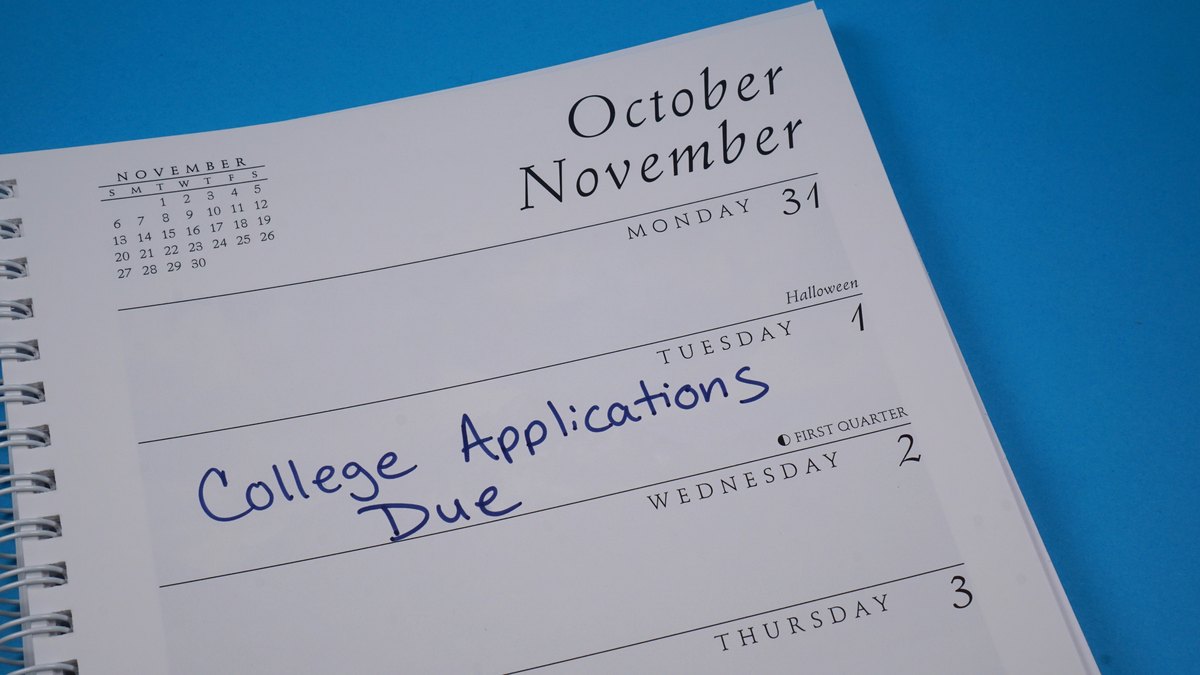
If your plan for this fall was built on advice from an older sibling, a friend's parent, or a video you watched two years ago, stop and check it. The early admissions landscape moved again this summer, and it moved in the direction it has been moving for a decade: more binding rounds, more early rounds, and a larger share of the freshman class decided before Regular Decision applications are ever read.
Seven colleges that Texas families apply to in volume added or expanded an early plan for Fall 2027 entry. Three of them created a binding round where none existed before.
None of these are cosmetic. When a college adds an early round, it is trying to solve a specific problem — usually yield, the share of admitted students who actually enroll. Understanding what the college gets out of the change is the fastest way to figure out what you should do about it.
What Actually Changed for Fall 2027
WashU added Early Action — and started counting demonstrated interest
Washington University in St. Louis now offers a non-binding Early Action round alongside its existing ED I, ED II and Regular Decision plans. Early Action applications are due November 2, with decisions released December 23 and a reply deadline of May 1.
Three other WashU changes matter just as much:
- The university now considers demonstrated interest in its review. Campus visits, virtual sessions and engagement with admissions reps are on the record.
- The optional writing supplement is gone. The 250-word response about your intended field of study remains required, and the optional 90-second video remains available.
- December 16, 2026 is a firm priority deadline for the Signature Scholar Programs and the Howard Nemerov Writing Scholars Program.
Expect a large jump in WashU's application volume this year. A selective university adding its first non-binding early option tends to attract everyone who wanted to apply early but wasn't ready to sign a binding agreement.
USC introduced Early Decision for nearly every program
Following a two-year pilot in the Marshall School of Business, USC now offers binding Early Decision across the large majority of its undergraduate programs. The deadline is November 1, with decisions in mid-December. Early Action and Regular Decision both continue.
The exceptions are the performance-based programs: the Kaufman School of Dance, the Thornton School of Music and the School of Dramatic Arts continue to admit through Regular Decision, deadline December 1.
For a university that has never had a binding round, this is a significant shift in how the class gets built.
The University of Florida added binding Early Decision
UF's new Early Decision round is single-choice and binding. Applications are due October 15 (supporting materials October 22), decisions arrive by December 11, and admitted students must confirm enrollment by January 8. It is open to all main-campus applicants; UF Online applicants are excluded.
UF's Early Action round continues — deadline November 1, decisions January 22 — as does Regular Decision, deadline January 15 with decisions March 19.
Note the trap in that calendar: UF's binding deadline falls two weeks before its non-binding one, and more than two months before Regular Decision. An October 15 deadline arrives before most seniors have a first-quarter grade, let alone a November SAT score.
Florida State added Early Decision — and narrowed Early Action
FSU now offers a binding Early Decision plan to domestic first-year applicants for Summer and Fall 2027 entry, the first in the State University System of Florida to do so. The deadline is October 15, decisions are released December 17, and admitted students must deposit by January 15, 2027.
Two details families miss:
- FSU's non-binding Early Action round is now available exclusively to Florida residents, on the same October 15 / December 17 timeline. For an out-of-state Texas applicant, the early option at FSU is now the binding one or nothing.
- Early Decision is not available for talent-based programs (Acting BFA, Athletics, Dance, Film, Music, Music Theatre, Stage Management BFA, Studio Art BFA) or the CARE Summer Bridge Program.
Occidental and Connecticut College added Early Action
Both liberal arts colleges introduced a non-binding Early Action round beginning with Fall 2027 entry, and neither round is restrictive.
Occidental: Early Action due November 1, decisions by mid-January. ED I is also November 1 with mid-December decisions; ED II and Regular Decision are both January 10.
Connecticut College: Early Action due November 1, decisions by mid-December, reply by May 1. Both Early Decision rounds continue.
Chapman added a second binding round
Chapman now runs two binding rounds: ED I, due November 1 with mid-December notification, and a new ED II, due January 15 with early-to-mid-February notification. Chapman will release an admitted ED student who cannot afford to attend.
Georgetown joined the Common App
Not an early-plan change, but it changes the early-season workload. Beginning August 1, 2026, applicants to the Class of 2031 can apply to Georgetown through the Common App as part of a three-year pilot; Georgetown's own application remains available, and the university says neither is preferred. Early Action is due November 1 and Regular Decision January 1.
Read Georgetown's early rule carefully, because it is unusual: Early Action is non-binding, but Georgetown EA applicants may not apply to any binding Early Decision program anywhere. You can stack other non-binding EA applications; you cannot pair Georgetown EA with an ED application.
Why Colleges Keep Adding Early Rounds
The honest answer is enrollment management, not student convenience.
A binding admit is a near-certain enrollment. When an admissions office fills a seat in December through Early Decision, it knows with almost total confidence that the seat is filled — which makes budgeting, housing, faculty planning and financial aid forecasting dramatically easier. Add enough of those and the uncertainty of Regular Decision shrinks to something manageable.
The numbers show how far this has gone. A 2026 analysis by College Transitions of Common Data Set filings from roughly 143 selective colleges that use ED found the average school now fills about 34.6% of its incoming class through binding early rounds, up from 31.9% two cycles earlier. Forty of those colleges fill more than half the class this way. Davidson, Middlebury and Emory each filled roughly 68-69% of a recent class through ED; Duke reached 60%, Northwestern 56%.
Meanwhile the early season keeps getting more crowded. Common App reported that through November 1, 2025, 962,284 distinct first-year applicants had applied to its 916 long-standing member colleges — up 5% year over year — submitting 4.7 million applications, up 10%. Students are applying to more colleges each (4.90 apiece, up from 4.68), and they are doing it earlier.
Former admissions officers describe the internal conversation as a series of quotas rather than a queue of qualified students: how many engineers, how many humanities students, how many full-pay students before the aid budget breaks, how many recruited athletes, how many seats can we responsibly commit before Regular Decision even opens. Andrew Hoffman, a former director of admissions at Swarthmore, puts it simply: every admissions office is building a class, not just admitting individual students. "Yes, qualified" is not the same as "admit."
What the Early Admit Rate Actually Tells You
Early admit rates are higher than regular ones almost everywhere. But the size of that advantage depends almost entirely on one thing, and it isn't the calendar.
Here is the most recent completed cycle — the students who applied in fall 2025 and started college this fall.
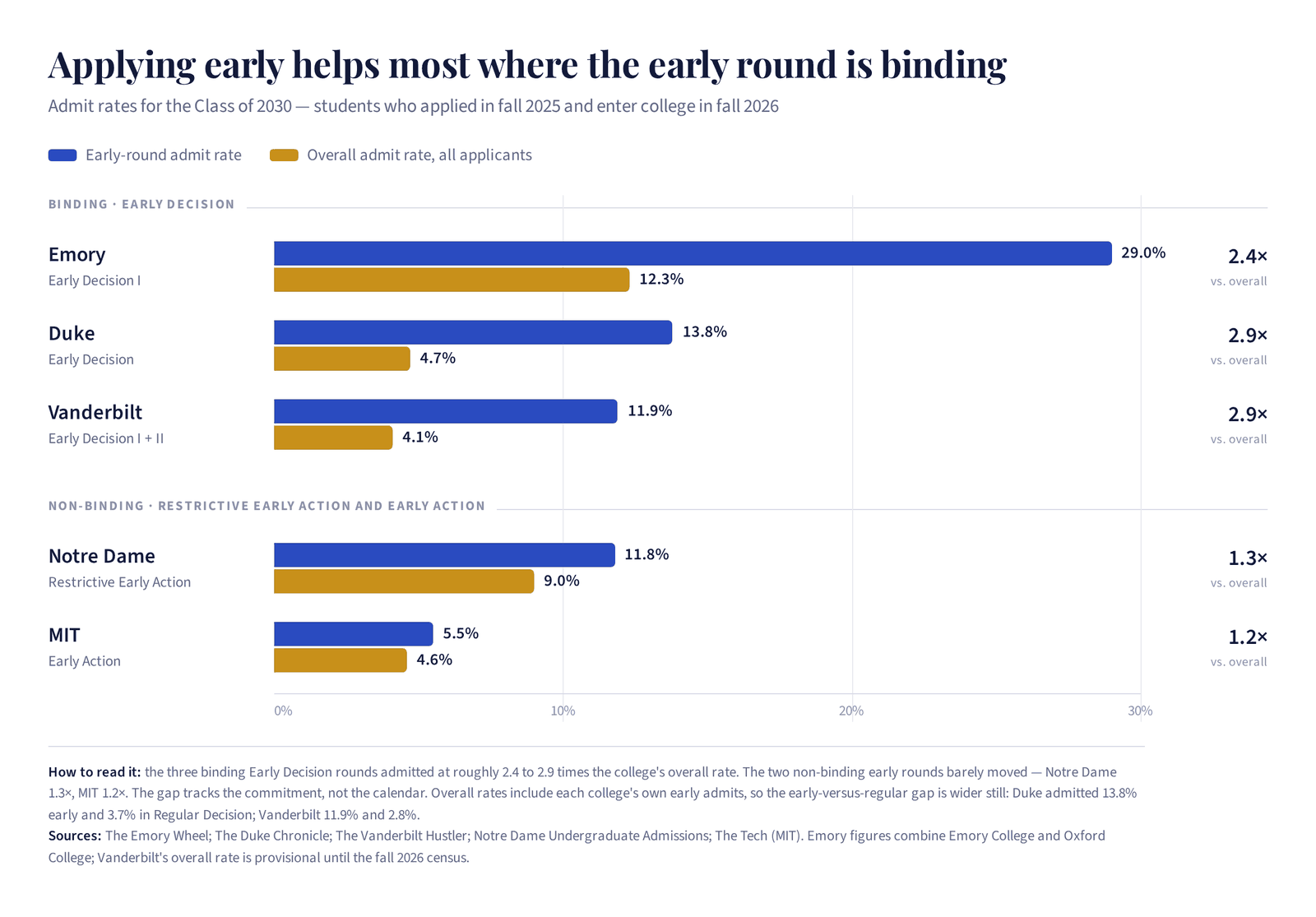
Read the binding group first. Emory admitted 29.0% of its Early Decision I applicants against an overall rate of 12.3%. Duke admitted 13.8% in Early Decision against 4.7% overall. Vanderbilt admitted 11.9% across its two binding rounds against roughly 4.1%. Each of those early rounds ran at about two and a half to three times the college's overall rate.
Now read the non-binding group. Notre Dame's Restrictive Early Action round admitted 11.8% against a 9% overall rate — a 1.3x difference. MIT's Early Action round admitted 5.5% against 4.6% overall. That is 1.2x, which is close to noise.
Every one of those five rounds is "early." Only three of them ask the student to promise to enroll. That is the entire pattern: the advantage lives in the commitment, not in the calendar. A college pays for certainty, and Early Decision is the only round where it gets any.
Two honest caveats, both of which matter more than the headline.
The chart understates the binding gap. "Overall" includes each college's own early admits, which drags the comparison toward the early number. Where colleges publish the Regular Decision rate separately, the real spread is brutal: Duke admitted 13.8% of Early Decision applicants and 3.7% of Regular Decision applicants. Vanderbilt, 11.9% against 2.8%. That is the comparison a senior deciding in October is actually facing.
The chart overstates what it means for you. None of these numbers control for who is in each pool. Early rounds are where recruited athletes, legacy applicants, QuestBridge matches and the most organized, best-prepared students in the class land. A meaningful share of every gap above is composition, not timing. The broader analyses say so directly — a 2026 review by College Transitions of Common Data Set filings from roughly 143 selective colleges found ED admit rates averaging 47% against a 39% overall rate, and notes plainly that it does not adjust for applicant strength.
Harvard says the same thing in its own words on its admissions site: it does not offer an advantage to students who apply early, and the higher early admit rate reflects the strength of the early pool.
The practical translation: applying early is a timing decision, not an upgrade to your application. An early application that isn't ready is a worse application submitted sooner. If your case improves materially with a first-semester senior grade, a November test score or three more weeks on your essays, the early round may be costing you more than it gives.
Read the Fine Print — It Differs by College
Restrictive Early Action and Single-Choice Early Action are non-binding, but they limit where else you can apply early, and no two policies are written the same way. Two examples from the same tier of schools:
Harvard (Restrictive Early Action, November 1, mid-December decisions) — you may not apply under Early Decision, Early Action or REA at any other private institution, and not to a binding early program at a public university. You may apply to public universities under non-binding plans, to military academies, to non-U.S. universities under non-binding plans, and to other colleges' Regular Decision. Harvard permits an Early Decision II application if you are deferred in its early round.
Yale (Single-Choice Early Action, November 1, mid-December decisions) — you may apply to non-binding rolling programs, non-binding early programs at public institutions, institutions outside the U.S., and, notably, to any ED or EA round that notifies after January 1 — the "Round 2" plans — without waiting for a Yale decision.
Same tier, same deadline, materially different rules about ED II. If you are weighing a restrictive early plan, read the policy page for that specific college, this year, before you build a list around it.
And for anyone wondering who would ever find out: your school counselor sends one transcript to one school in the early round. Counselors also sign the Early Decision agreement. The system has been designed to notice.
The Texas Picture
Nothing changed this year at the two public flagships most Frisco and Collin County families apply to, but the deadlines still catch people out:
- UT Austin — Early Action deadline October 15 (supporting documents October 22), decisions by January 15. Regular deadline December 1, documents December 10, decisions February 15. UT's round is non-binding and the university does not claim it gives any advantage in review; it is a timing difference only. Automatic admission for Texas residents stands at the top 5% for Summer/Fall 2027 entry.
- Texas A&M — applications open August 1 and close December 1 (documents December 15). A&M reviews on a rolling basis and begins releasing decisions in late September. Nothing is binding, but early in a rolling process is genuinely early.
- Rice — ED I November 1 (mid-December decisions), ED II January 4 (late-January decisions), Regular Decision January 4 (April 1).
- SMU — Early Action and ED I both November 1; ED II and Regular Decision both January 15.
- TCU — Early Action and ED I both November 1, with notification by January 1.
If you are a Texas senior targeting UT Austin plus a private with a binding round, sequence matters: UT's October 15 deadline lands two weeks ahead of nearly every November 1 early deadline in the country. Treat it as the first domino, not the last.
How to Decide
Do not start with "where can I apply early." Start with: where would I unquestionably enroll if admitted, without seeing another offer?
If there is a clear answer to that question, and the college is affordable, and your application is genuinely ready by the deadline, Early Decision is one of the strongest strategic moves available to you.
Apply Early Decision when: - One college is a clear, researched first choice — not a name you inherited from someone else's list - You have run that college's Net Price Calculator with your family's actual numbers and saved the result as a PDF - The college meets a high share of demonstrated need, or your merit picture doesn't depend on comparing offers - Your application is strong right now, not in February
Apply Early Action or Regular Decision when: - You need to compare financial aid or merit scholarships before committing - Your list is still genuinely open - First-semester grades or a fall test score will meaningfully change your case - You are targeting a restrictive plan whose fine print would block a better option elsewhere
On the Early Decision agreement
Students, parents and the school counselor all sign it. It is not a legal contract, but admissions offices treat it as binding in practice, and offices talk to each other. Students have had offers rescinded for keeping applications live after an ED admit in order to shop financial aid. Applying ED "just to see" takes a seat from a student who meant it.
The one real escape hatch
Affordability. If you are admitted ED and the aid package is substantially worse than the college's own Net Price Calculator predicted, that is a conversation to have, not a verdict to accept: contact the financial aid office, show them the calculator output you saved, and appeal with any unusual circumstances documented. Appeals move real money. If the number still doesn't work after that process, you can be released from the commitment — which is exactly why running the calculator before you apply is non-negotiable.
The Short Version
More colleges added early rounds this year, more of them are binding, and a larger share of every class is being decided before Regular Decision opens. That is a real trend and it is not reversing.
It is still not a reason to apply early to the wrong school. The students who get the most out of these rounds are the ones who used the summer to build a real list of 20-30 colleges across selectivity levels, found the one they would genuinely commit to, and arrived at November 1 with an application that was finished rather than rushed.
Applying early isn't the goal. Getting it right is.
Lone Star Scholars works with Frisco and Collin County families on exactly these decisions — list building, early-round strategy, and the financial aid math behind a binding commitment. If you want a second read on your early plan before November 1, schedule a consultation.
For the underlying mechanics of each plan, see our complete guide to Early Decision, Early Action and ED II. If an early decision doesn't go your way in December, read Denied Early: Why It's Not the End.
Ready to Get Started?
Schedule a free consultation to discuss your student's goals and create a personalized plan.
Book Free Consultation